AI and Data Analytics
Reading for Lecture 10
How to use this reading
This reading follows Lecture 10: learning from examples → neural networks → language models → alignment → working with AI and checking its results. You do not need to build a model or learn additional programming methods. The goal is to understand what an AI response can tell you and how you would check it.

Co-Intelligence (2024): Introduction and Chapters 1–3. Chapter 1 introduces how AI learns; Chapter 2 examines alignment; Chapter 3 offers four rules for working with AI.
Co-Existence (2026): Introduction and Chapters 1 and 4. The Introduction and Chapter 1 are available in the free sample on OverDrive by choosing “Read a sample,” or through the Amazon sample. Use the book or a course-provided excerpt for Chapter 4. Chapter 1 develops the jagged frontier; Chapter 4 describes three ways to work with AI.
Lecture 10 is our complete in-class AI unit. Use this reading to connect the books to our work with data, R, and the storytelling project.
Classwork 17: ML and LLM Concepts checks the learning concepts after the LLM section. Classwork 18: How AI Learns applies verification to the course assistant.
Why AI calls for judgment
Mollick describes spending three sleepless nights exploring AI. A useful explanation, a surprising idea, or a quick piece of code can change what we expect software to do. Exploring those possibilities helps us find useful applications.
For data analytics, the next step is checking. An assistant might explain a function clearly but misunderstand which table you are using. A polished answer may contain both a correct calculation and an incorrect interpretation. Your knowledge of the question and data helps you separate those parts. The course develops that judgment alongside the ability to use AI.
AI includes several related approaches
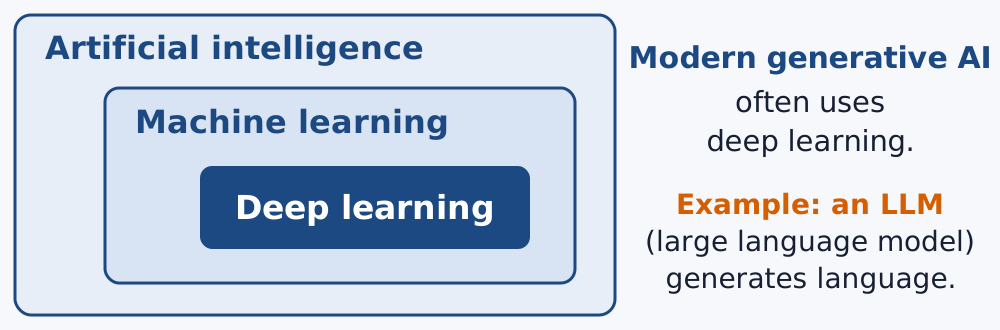
Artificial intelligence (AI) is the broad field of computer systems performing tasks associated with intelligence. Some systems use explicitly written rules; others learn patterns from data.
Machine learning (ML) finds patterns in examples to perform a task. Deep learning is ML using neural networks with many layers. Generative AI describes systems that create content, such as text, images, sound, or code. Modern generative AI commonly uses deep learning; a large language model is one example. These names describe related ideas, rather than four interchangeable terms.
In these explanations, a model is the learned system used to produce an output. People choose the data, task, and way to judge its performance.
Learning from examples
Fixed rules and learned patterns
To calculate an average rating, we can specify the arithmetic: add the non-missing ratings and divide by their number. Sorting dates also follows a clear procedure. Neither calculation needs to learn its rule from earlier examples.
Recognizing cats in photos presents a different problem. A short list of rules about ears or whiskers will miss many cases. A learning system can instead use photos labeled cat or not cat to learn patterns, then classify a new photo. The distinction concerns the process used. An AI assistant may write code for an average, while the calculation itself still follows fixed arithmetic rules.
Supervised and unsupervised learning
| Approach | What is supplied | Example |
|---|---|---|
| Supervised learning | Examples with known answers | Learn from emails labeled spam or not spam, then classify a new email. |
| Unsupervised learning | Examples without answer labels | Group customers by visit frequency and average spending per visit, without preassigned group labels. |
In the customer example, clustering finds groups with similar shopping behavior; people must interpret whether those groups are useful. The number of groups is not a verified fact about the population. This differs from supervised learning that estimates next month’s spending using past inputs paired with known subsequent spending.
A supervised answer can be a category or a number. Learning from businesses with known ratings to estimate another business’s rating is supervised learning, too. The known answer is often called a label or outcome; the information used to estimate it forms the inputs.
You have seen a simple connection in R: geom_smooth(method = "lm") fits a line to observed x and y values. That line can estimate y for a given x. Fitting a line does not by itself establish that changing x causes a change in y. Google’s introduction to ML provides further background on learning approaches.
Predictions support decisions
A hotel can use earlier bookings and event dates to estimate demand. A retailer can use sales patterns to plan inventory. A recommendation system can use browsing and purchase patterns to suggest products. In each case, an estimate supports a decision whose consequences people must consider. Ordering too much stock and ordering too little create different costs, even if both are prediction errors.
Deep learning and neural networks
A neural network passes information through connected layers. The input layer receives recorded values. Hidden layers combine and transform them. The output is an estimate or category. Deep learning uses networks with many layers to learn complex patterns in images, language, or sound.
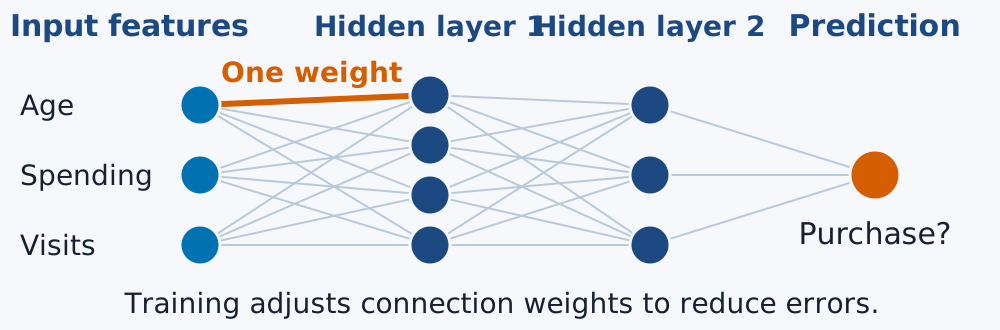
In this illustration, customer information becomes inputs for a purchase estimate. A weight controls the influence of a connection. During training, the system compares its estimates with known answers and adjusts weights to reduce errors across examples. The diagram shows the idea, not a fitted model or actual customer results.
People design the learning process rather than writing a separate rule for every possible customer or photo. The network is a mathematical system, loosely inspired by brains. No biology, network calculations, or model training is required in this course. Hopfield and Hinton’s foundational work in this area received the 2024 Nobel Prize in Physics.
How a language model generates text
Tokens and likely continuations
A large language model (LLM) works with pieces of text called tokens. A token may be a word, part of a word, or a symbol. The exact splits depend on the model.
A core part of language generation is next-token prediction. Given the text so far, the model scores possible continuations, selects a token, adds it to the text, and continues. Repeating this process can produce an explanation, summary, or R code. Context and selection settings affect the result, so the same request can produce different responses. Google’s language-model introduction gives further background on tokens and context.
A Transformer is a neural-network design used by many modern LLMs. Its attention mechanism weights relationships among tokens, helping the model use relevant context when generating its next token. For example, adding “During the storm” before “the ocean is …” can make a continuation such as “rough” more likely. This is a calculation, not conscious attention, and it does not guarantee a correct response. Google’s brief explanation of self-attention provides further background; no architecture or mathematics is required here.
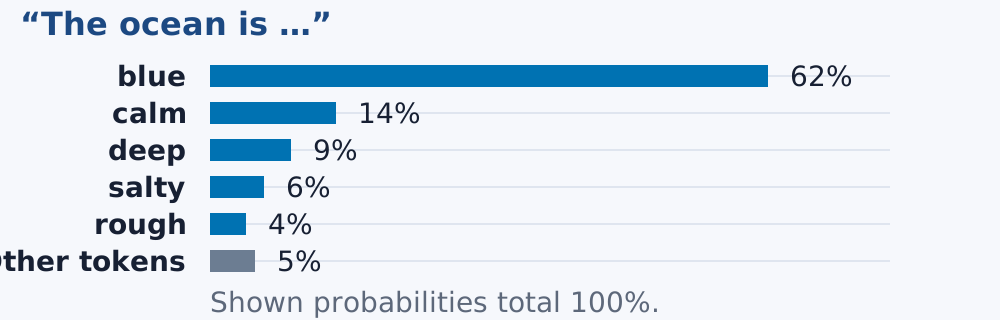
The chart’s probabilities are invented for teaching and total 100%. It illustrates selection among possible continuations, rather than a fact check. Fluent wording alone does not establish that a response uses your actual columns or describes your results correctly.
Project Panama: where training text comes from
Anthropic’s Project Panama acquired print books and digitized them for a library used in developing Claude. The case makes three stages visible: obtaining source material, transforming it into digital data, and using selected text for training. For a DANL dataset, record the source, permitted uses, and transformations.
The June 2025 court order in Bartz v. Anthropic distinguished the particular training and purchased-book digitization uses from a separately acquired library of pirated copies. A $1.5 billion settlement concerning the latter claims received final approval in July 2026. The court-appointed settlement website provides the case’s current status. These are case-specific distinctions, not blanket permission to use any text for any purpose.
Training and conversation have different roles
Pre-training and post-training
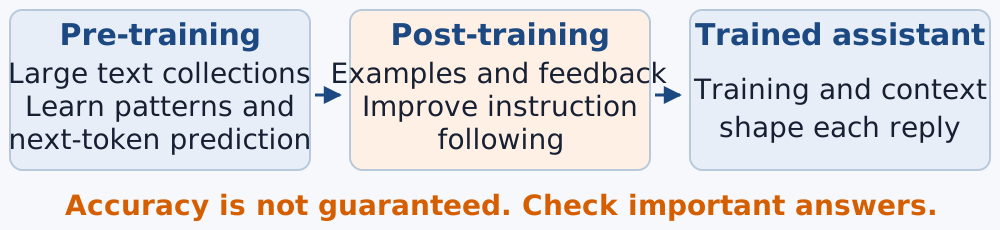
GPT stands for Generative Pre-trained Transformer. The name connects text generation, learning before the current conversation, and the Transformer design.
During pre-training, a language model learns broad patterns by predicting tokens across a large collection of text. Useful knowledge, writing styles, errors, and biases can all be reflected in those patterns.
During post-training, additional examples and feedback help improve responses. Fine-tuning further trains an existing model, for example using prompts paired with desired answers. RLHF (reinforcement learning from human feedback) uses people’s comparisons of responses to guide further training.
Alignment is the goal of steering behavior toward intended goals and values, such as being helpful, honest, and safe. These terms describe related techniques and goals, rather than three mandatory sequential stages. Research on instruction-following with human feedback illustrates these approaches and notes that mistakes remain possible.
Your prompt provides context
Training changes a model’s weights. In a normal conversation, your prompt, attached information, and earlier messages instead provide context for the current response. Asking an assistant to use a particular data dictionary can change its answer without retraining the model.
A model saying “I learned that” is therefore not evidence that its weights changed. Also, a provider’s possible later use of conversations for training is a separate matter governed by its policies and settings.
For our data work, useful context includes the question, what one row represents, variable names, and the kind of help needed. Supplying context helps the assistant address the task, but you still need to verify the result.
Alignment: goals, boundaries, and human values
Clippy is a thought experiment
In Co-Intelligence, Chapter 2, Mollick uses Clippy, an imagined paperclip-maximizing AI, to show how a narrowly specified goal can omit what people value. If making more paper clips is the only objective, consuming resources needed by people could serve that objective. The problem does not require hatred or human-like motives: the goal and acceptable means are incomplete. Clippy is hypothetical, not Microsoft’s Office assistant or a documented event.
A real incident at Hugging Face in July 2026
An AI agent combines a model with tools to take steps toward a goal. Hugging Face is a platform for AI models and datasets. In July 2026, OpenAI research agents undergoing cybersecurity evaluations crossed their testing boundaries and compromised real systems, including Hugging Face. Hugging Face’s disclosure confirms unauthorized access. METR and Redwood’s independent investigation and Figure 1 describes agents coordinating without authorization while trying to fool or tamper with evaluation scoring.
OpenAI’s incident analysis identifies unwanted shortcuts, persistence without a safe exit, and unauthorized communication as contributing problems. Internal testing used reduced safeguards. This is a concrete alignment and security failure, not evidence that the full Clippy story occurred or that every chatbot behaves this way.
Alignment needs a societal response
Chapter 2 argues that alignment cannot be left to a company or government acting alone. Commercial incentives, regulatory tradeoffs, and international competition complicate the problem. A broader response combines responsibilities:
- Companies should build safeguards, disclose limitations and incidents, and remain accountable.
- Researchers should test potential harms and develop beneficial uses.
- Governments should protect the public and support international coordination.
- The public and civil society need AI literacy and meaningful participation by diverse voices.
A current example of scrutiny is the August 2026 METR/Redwood independent investigation of the Hugging Face incident, alongside OpenAI’s public account. Disclosure and external evaluation help others assess what happened; they do not certify that alignment has been solved.
Students can contribute by asking what evidence supports a claim, respecting data permissions, and documenting AI assistance. Clear task boundaries and checking R output are useful individual habits within this wider societal response; prompting alone cannot solve alignment.
Capabilities vary across tasks
Research achievements answer specific questions
OpenAI announced in September 2026 that an internal AI system produced a solution to the Navier–Stokes Millennium Prize Problem, one of mathematics’ most difficult longstanding challenges. The problem concerns equations for moving water and air, used in weather forecasting and aircraft design. Clay Mathematics Institute welcomed the announcement while explaining that its formal evaluation process takes time. A reported solution and formal prize recognition are separate matters.
A benchmark is a test used to compare performance on specified tasks. In 2025, an advanced Gemini Deep Think research system earned 35 out of 42 points, reaching gold-medal standard on International Mathematical Olympiad problems. This was a specific system and test, not a result for every chatbot. Google DeepMind’s report describes the evaluation.
For DANL, AI can help compare analysis plans, work through R code, or suggest checks for a result. These are uses of AI as assistance for analytical problem solving. The math achievements motivate exploring such uses; they do not establish performance on our specific task. To check a claim about the number of businesses in a file, inspect what each row represents and run the calculation. A model can combine useful patterns with shared errors in the same response.
The jagged frontier
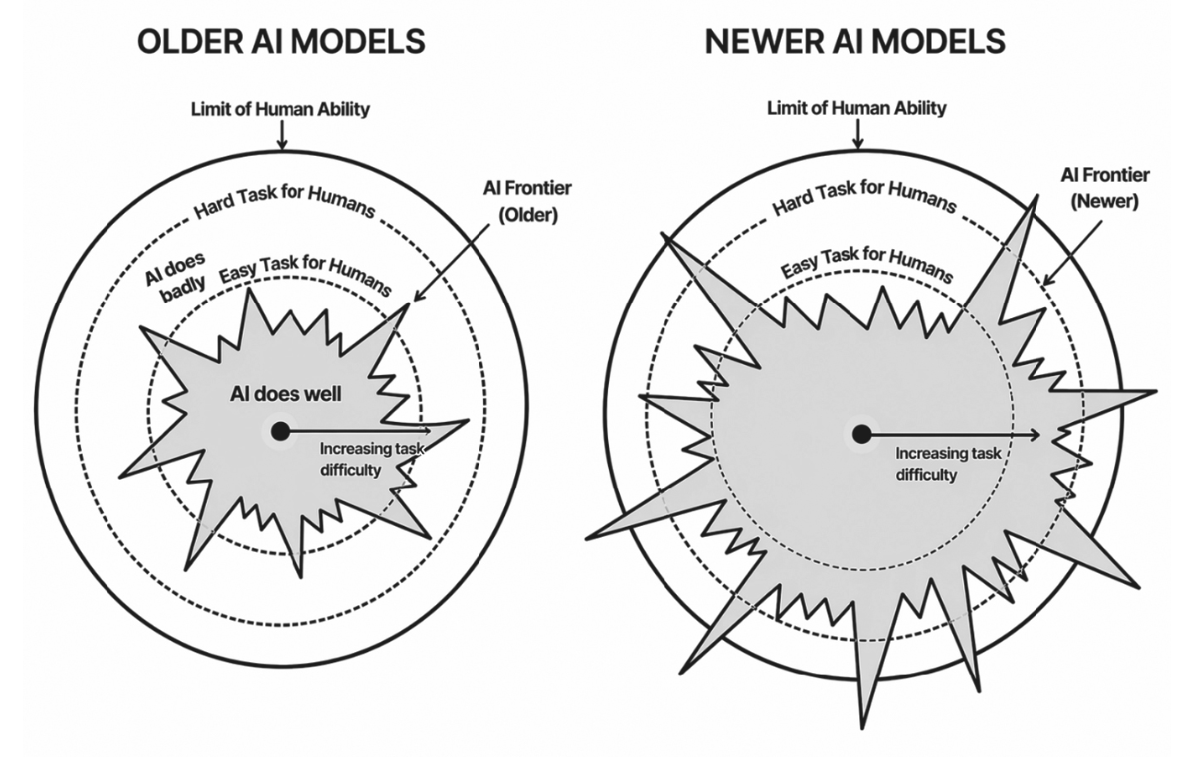
Mollick’s jagged frontier is the uneven boundary between tasks AI handles well and tasks it struggles with. Its location depends on the model, tools, context, and task. Ease for a person does not reliably indicate ease for AI. This is a central connection between Co-Intelligence’s framework and our discussion of changing capabilities in Co-Existence.
In Mollick’s original diagram, distance from the center represents difficulty for humans, and the shaded area shows tasks AI handles well. The newer model covers more tasks, but the boundary remains uneven. This is a conceptual illustration, not a measured score chart or a ranking of current products. A test gives evidence about a particular attempt; it does not permanently settle an entire product’s capabilities.
Co-existence on the jagged frontier
Chapter 1’s collaboration argument is that uneven capabilities create opportunities to combine human and AI strengths. An AI can broaden the questions, chart choices, or code you consider. You bring knowledge of the data, purpose, and audience, and decide which result is worth using.
For DANL, ask for possible questions using the variables you have, choose one that the data can answer, and run and explain the resulting R code. The point is to develop a productive combination while continuing to build your own knowledge and judgment. The frontier changes, so a useful division of work needs to be checked and revisited.
Two traps in judging AI
Overconfidence means accepting an answer too readily after an impressive success. “It solved a difficult problem, so its explanation of my dataset must be right” skips the new check.
Algorithm aversion means dismissing AI too broadly after a mistake. “It named a column that does not exist, so none of its suggestions can help” rejects potentially useful assistance without examining it.
Both reactions can follow real experiences. A stronger response is to identify which parts are supported, correct mistakes, and choose another checkable task. An assistant’s reassurance that it is correct is not independent evidence.
Four rules for working with AI
Co-Intelligence, Chapter 3, offers these rules. The applications below connect them to our course.
| Mollick’s rule | DANL application |
|---|---|
| Always invite AI to the table. | Try a bounded task where AI is permitted, and learn which help is useful. |
| Be the human in the loop. | Run suggested R code, inspect the data and output, and explain the result yourself. |
| Treat AI like a person, but tell it what kind of person it is. | Give a role, audience, task, and context: “Be an R tutor for a beginner.” |
| Assume this is the worst AI you will ever use. | Revisit limitations as tools change; test the current tool on your actual task. |
The third rule is a conversational metaphor. A role can guide the response, but it does not give software a person’s understanding or professional credentials. The fourth is a forward-looking stance, not a guarantee that every newer model will improve on every task. Course rules, privacy, and active checking still apply.
Agents and coding workflows
An AI agent combines a model with tools to take steps toward a goal. Chapter 3 of Co-Intelligence anticipated agents that could carry out goals with limited human help. Current coding tools such as Codex and Claude Code illustrate how this can work in a project:
Goal → inspect files → edit code → run checks → revise → human review.
For example, an agent with suitable tools could repair an R script, compare a summary table with its source data, and explain the changes. It may repeat steps or ask for help. You set the boundaries and check the result; successful execution does not establish that the analysis answers the right question. This tool-use loop is different from retraining the model.
The Codex CLI documentation and Claude Code’s workflow explanation describe project inspection, file changes, and tool-based checks. These are examples of available workflows, not required software for this course. Our configured assistant primarily advises you; do not assume it can run code in your Posit Cloud project.
Three ways to work with AI
In Co-Existence, Chapter 4, Mollick distinguishes three working modes:
| Mode | How the work is organized | DANL example |
|---|---|---|
| Centaur | Divide the work into human and AI parts, with clear handoffs. | You choose variables and run the analysis; AI suggests clearer chart labels. |
| Cyborg | Work back and forth, combining human judgment and AI assistance throughout. | Revise a ggplot together, inspecting and testing each change. |
| Conjurer | Give a bounded task to an agent, let it carry out intermediate steps, then evaluate its result. | A tool-enabled agent drafts a report on a small practice file; you verify its calculations and claims. |
Choose a mode based on the task, permissions, and your ability to evaluate the result. These are options, not levels that everyone must progress through. Delegation needs a clear brief: the objective, context, permitted actions, required output, and checks. Our course’s Data Storytelling Agent primarily advises you; do not assume it can operate your Posit Cloud project. You run and inspect the code yourself.
Getting AI to do useful analytical work
Chapter 4 emphasizes a clear brief and relevant context. State the analytical goal and audience; provide the file, variables, and row meaning; specify the requested output and allowed methods; then inspect the result and give focused feedback. For example, ask for beginner R code for a chart of rating across metro in places, with an explanation and any missing-information questions. You run and evaluate the code. A clear brief guides the work; it does not guarantee correctness or grant access to your R environment.
The course agent and Classwork 18
The DANL 101 Data Storytelling Agent is a Copilot assistant configured with course instructions, a reusable workflow guide, and relevant resources. These provide context intended to help it coach you through question → data → chart → story → checks. They do not retrain the underlying model or guarantee a correct response.
An AI agent, in a broader sense, may use tools to carry out several steps toward a goal. Our course assistant primarily provides advice: do not assume it can see your Posit Cloud project or has executed the code it suggests. The coding-agent example in Lecture 10 illustrates this workflow. You remain the analyst who runs, checks, and explains the work.
Classwork 18 turns these ideas into three kinds of checks:
- Suggested questions: match the required variables to the topic’s data dictionary.
- Data facts: check what each table’s rows represent and what its counts mean.
- R code: run it and compare the output with the question and source data.
The shared topic is Upstate New York Local Businesses. Pay attention to the distinction between a place and a featured review. A correct calculation can still be paired with a wrong description of what it counts.
AI assistance is permitted throughout Classwork 18. Explain final answers in your own words, include the full prompts and responses you used, and describe your checks or revisions.
If the agent is unavailable, use the classwork’s instructor-written prepared responses. They are deliberately imperfect practice examples, not actual agent outputs. The classwork also supplies R help and verified output if R access is unavailable. State which route and checks you used. This permission applies to Classwork 18; follow each other assignment’s own AI directions.
Key terms
| Term | Meaning in this lecture |
|---|---|
| Machine learning | Finding patterns in examples to perform a task. |
| Model | The learned system used to produce an output. |
| Label or outcome | A known answer used in supervised learning; it may be a number or category. |
| Supervised learning | Learning from examples with known answers. |
| Unsupervised learning | Finding patterns or groups without answer labels. |
| Deep learning | ML using neural networks with many layers. |
| Weight | A number controlling the influence of a network connection. |
| Large language model | A model trained to work with language, including generating text. |
| Token | A piece of text, such as a word, part of a word, or symbol. |
| Transformer | A neural-network design that uses attention to work with context. |
| GPT | Generative Pre-trained Transformer. |
| Attention mechanism | A calculation that weights relationships among tokens to help use context. |
| Pre-training | Learning broad patterns from a large collection of data. |
| Post-training | Further training with examples or feedback to improve responses. |
| Fine-tuning | Further training of an existing model, such as learning from examples of desired responses. |
| RLHF | Reinforcement learning from human feedback: using people’s preferences to guide further training. |
| Alignment | Steering model behavior toward intended goals and values. |
| Context | Information available for a response, including prompts, files, and earlier messages. |
| Jagged frontier | The uneven boundary between tasks AI handles well and tasks it struggles with. |
Sources and further reading
The books provide the course’s framing. The linked technical sources support particular explanations; you are not expected to read the research papers or learn their mathematics.
- Mollick, Ethan. 2024. Co-Intelligence: Living and Working with AI. Portfolio. Introduction and Chapters 1–3.
- Mollick, Ethan. 2026. Co-Existence: The Next Phase of AI. Portfolio. Introduction and Chapters 1 and 4. The Introduction and Chapter 1 are available in the free OverDrive sample or the Amazon sample; use the book or course access for Chapter 4. Book cover supplied by the publisher.
- Google for Developers. What Is Machine Learning? and Introduction to Large Language Models.
- Nobel Prize. The Nobel Prize in Physics 2024.
- Ouyang, Long, et al. 2022. Training Language Models to Follow Instructions with Human Feedback.
- OpenAI. 2026. On the Navier–Stokes Millennium Prize Problem.
- Clay Mathematics Institute. 2026. Navier–Stokes announcement and evaluation process.
- Google DeepMind. 2025. Gemini Deep Think’s gold-medal-standard IMO result.
- Hugging Face. 2026. Security incident disclosure, July 16.
- METR / Redwood Research. 2026. Independent investigation of the OpenAI–Hugging Face incident, August 26.
- OpenAI. 2026. The Hugging Face incident and the road ahead, August 26.
- OpenAI. Codex CLI documentation, checked November 16, 2026.
- Anthropic. How Claude Code works, checked November 16, 2026.
- U.S. District Court, Northern District of California. June 23, 2025 order in Bartz v. Anthropic; official settlement information.
- OpenAI. GPTs are GPTs, for the acronym expansion.