Lecture 9

Career Paths in Data Analytics and Beyond

Byeong-Hak Choe

SUNY Geneseo

👥 Andy and Oliver

October 30, 2026

👥 Meet Andy and Oliver

Profiles at the October 30, 2026 session
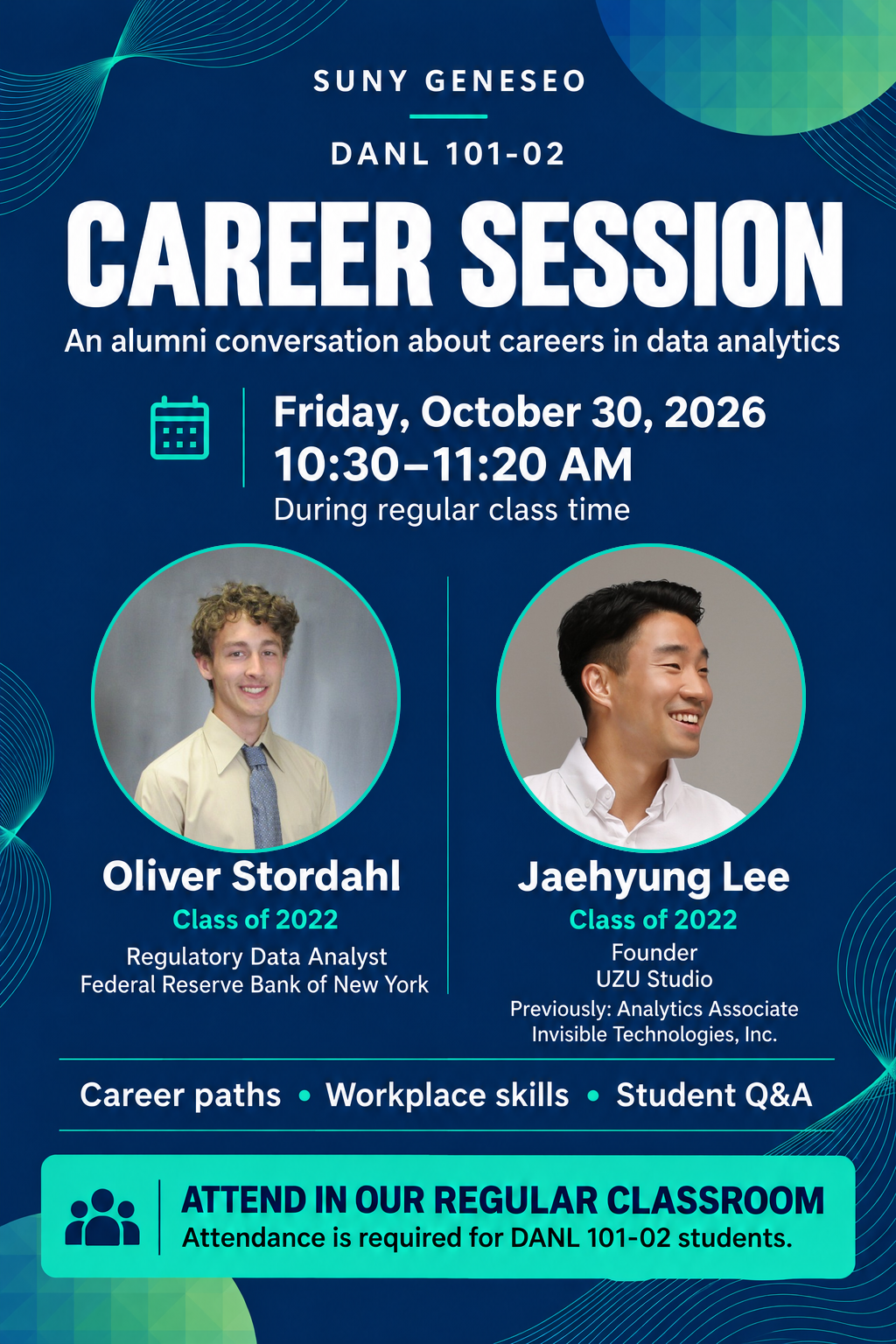
Jaehyung Andy Lee

Jaehyung “Andy” Lee

Geneseo Class of 2022

Major: Mathematics

Concentration: Data Analytics

Founder, UZU Studio

Previously an Analytics Associate at Invisible Technologies

Data pipelines, dashboards, and a startup supporting dental-practice owners

Oliver Stordahl

Oliver Stordahl

Geneseo Class of 2022

Major: Economics

Minors: Mathematics and Data Analytics

Regulatory Data Analyst, Federal Reserve Bank of New York

Bank-data checks, follow-up with reporting firms, and monthly reports

👋 What are your career backgrounds and current roles?

4:05

💼 How did you find your first job, and what helped you prepare for interviews?

2:58

🗓️ What does your day-to-day work look like?

3:52

🧭 How did you handle uncertainty about your career after graduation?

2:13

🔎 How did you discover the kind of work you wanted to pursue?

2:14

🛠️ Which skills matter most at work, and how did college help you develop them?

3:45

🤖 How is AI changing your work and the job market?

3:35

🎓 How can students make the most of college to prepare for their careers?

2:23

🎙️ Marcie Hogan

November 4, 2026

🎙️ Meet Marcie Hogan

Profile at the November 4, 2026 session
Marcie Hogan

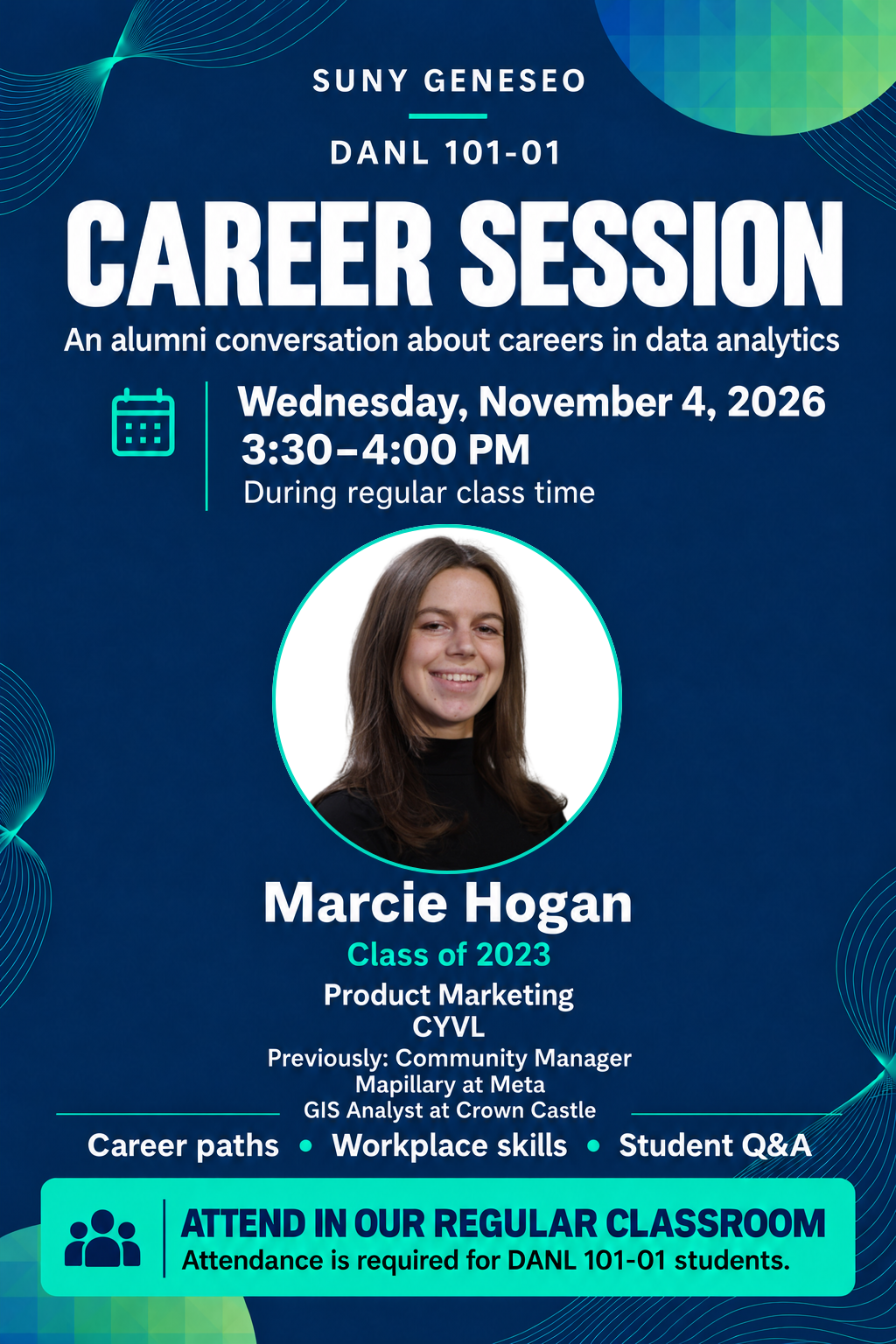
Marcie Hogan

Geneseo Class of 2023

Geography major with minors in physics and mathematics

Product Marketing and Customer Education Lead at Cyvl, a Boston government-technology startup

Earlier experience at Brookhaven National Laboratory, Crown Castle, Meta Mapillary, and the MBTA

Uses data in customer education, dashboards, and product strategy

👋 What is your background, and what do you do at Cyvl?

1:42

🗺️ How did internships and early roles shape your career in data and geospatial technology?

7:25

🧭 What did changing jobs teach you about finding the right career fit?

3:40

🚀 What is startup work like at Cyvl, and how does the pay compare?

5:49

🤖 Why do strong data skills still matter when AI can write code and build dashboards?

4:30

🌱 What career lessons helped you find work you enjoy and continue growing?

2:37

🤝 How can students find job opportunities and build authentic professional connections?

5:02

🗓️ What does a typical day look like in your role at Cyvl?

2:22

🔗 How did a LinkedIn conversation turn into a job offer at Cyvl?

1:40

💻 If you could learn only one programming language, which would you choose and why?

1:03

🌟 How can students manage career uncertainty and prepare for their first internship?

2:55

🧭 Career lessons and my thoughts

Shared themes and career preparation

🧭 Career uncertainty and finding a fit

From the guests

  • Andy and Oliver: interests in programming, problem solving, and economics gave them starting points. Their first jobs helped clarify what they enjoyed.
  • Marcie: research, GIS, product work, and other roles taught her what fit and when to change direction.

My thoughts

I also felt uncertain as an undergraduate, and my own path included unexpected turns. Meet people, gather information, and take informed risks as you refine your next step.

🧪 Projects and first internships

From the guests

  • Andy: a meaningful project gave him work he could explain deeply in interviews.
  • Marcie: courses, physics research, and campus experience helped her obtain internships. Her Crown Castle internship became her first full-time job.
  • Oliver (2025 session): Fed Challenge and FDIC Challenge provided applied data work, teamwork, and concrete interview stories.

My thoughts

Use college to develop critical thinking and creative problem solving. The exact material may differ from your future job, but learning how to approach an unfamiliar problem carries over.

🤝 Finding opportunities

From the guests

  • Oliver: broad applications and deliberate interview practice were his route into work.
  • Andy: interviewing and networking improve with practice.
  • Marcie: follow people in your field, have authentic coffee chats, and consider roles beyond the title “data analyst.”

My thoughts

Use the Career Center and Geneseo network. Combine outreach with preparation so you can demonstrate your skills when an opportunity appears.

🗓️ Daily work and workplace fit

From the guests

  • Oliver: a monthly cycle of bank-data checks, questions, reporting, and process improvements.
  • Andy and Marcie: stakeholder or customer conversations, technical work, and varied startup responsibilities. Andy also described work–life balance challenges.

My thoughts

Technical skills work alongside communication and business judgment. Understand the problem people are trying to solve and explain what your analysis means for them.

🛠️ Data foundations across careers

From the guests

  • Andy: course skills helped with a hiring task.
  • Oliver: learning to transform and visualize data helped him solve unfamiliar problems independently.
  • Marcie: data skills remained useful as her role shifted into product marketing and customer education. Python, R, and SQL can each provide a foundation.

My thoughts

Not everyone needs to become a data analyst. Quantitative reasoning helps across careers. Learn the logic in R—transforming data, comparing groups, and interpreting patterns—and carry it into new tools and roles.

💻 Languages, dashboards, and Excel

My thoughts

  • Python and R: both respected; Python is common in industry, R in statistics and research.
  • SQL: query, join, and summarize database tables.
  • Dashboards: practice Tableau and Power BI.
  • Excel: clean and summarize data, and check results.
  • NYS Data Analyst 1: preferred tools include Python, R, SQL, and Tableau; duties include data wrangling and clear reporting.

Revisit Lecture 2: R vs. Python—IBM overview

🎓 Communication and learning with others

From the guests

  • Andy and Oliver: interesting courses, clubs, friendships, and group projects are opportunities to explore and practice collaboration.
  • Marcie: explaining ideas to customers and learning from colleagues are central to her work and growth.

My thoughts

Much information is available online. One value of university is learning and working with other people. Use group projects, courses, and campus activities to develop communication skills and learn from your peers.

🤖 AI and analytical judgment

From the guests

  • Andy and Marcie: AI changed parts of their coding, reporting, and dashboard workflows. Choosing useful questions and evaluating results still mattered.
  • Oliver: entry-level work and training raise difficult questions. He avoided a confident prediction about long-run employment.

My thoughts

I use AI in my work, and I still need the skills to evaluate its output. Analytical understanding helps you decide whether a result makes sense.

Next: What do the labor-market signals tell us, and how can students prepare?

🐦 AI and young workers: signals to watch

  1. Stanford: finds weaker employment growth among young workers in AI-exposed occupations, mainly through reduced hiring. The authors describe this as observational evidence, not proof of causation. Stanford study
  2. Yale: finds no clear AI-related shift in broad labor-market measures so far. Yale analysis

Early evidence suggests weaker hiring for some young workers, while broader employment effects remain unclear.