library(tidyverse)
library(rmarkdown)
library(arules)
library(arulesViz)
library(plotly)Association Rules
Music Data
📌 Overview
This classwork analyzes a music-listening transaction dataset using association rules.
Each transaction represents one listener, and each item represents one artist listened to by that listener.
We will use arules for transaction objects and association-rule mining.
🎧 Load the Music Transaction Data
path_music <- "https://bcdanl.github.io/data/music_old.tsv"

music_eg <- read.transactions(
  file = path_music,
  format = "single",
  header = TRUE,
  cols = c(1, 2),
  rm.duplicates = TRUE
)
1️⃣ Column and Row Labels
Question 1
What do the labels for the column and the row of music_eg represent?
Answer
In the transaction matrix:
- The columns represent artists.
- The rows represent listeners.
- A cell is marked as present when a listener listened to a given artist.
# First 10 artist labels
colnames(music_eg)[1:10]
[1] "...and you will know us by the trail of dead"
[2] "[unknown]"
[3] "2pac"
[4] "3 doors down"
[5] "30 seconds to mars"
[6] "311"
[7] "36 crazyfists"
[8] "44"
[9] "50 cent"
[10] "65daysofstatic" # First 10 listener labels
rownames(music_eg)[1:10] [1] "1" "1000" "10000" "10002" "10003" "10004" "10006" "10007" "10008"
[10] "10009"# All item labels are artist names
itemLabels(music_eg) |> head(10) [1] "...and you will know us by the trail of dead"
[2] "[unknown]"
[3] "2pac"
[4] "3 doors down"
[5] "30 seconds to mars"
[6] "311"
[7] "36 crazyfists"
[8] "44"
[9] "50 cent"
[10] "65daysofstatic" The transaction dataset can also be summarized using summary().
summary(music_eg)transactions as itemMatrix in sparse format with
15000 rows (elements/itemsets/transactions) and
1004 columns (items) and a density of 0.01925312
most frequent items:
radiohead the beatles coldplay
2704 2668 2378
red hot chili peppers muse (Other)
1786 1711 278705
element (itemset/transaction) length distribution:
sizes
1 2 3 4 5 6 7 8 9 10 11 12 13 14 15 16 17 18 19 20
185 222 280 302 359 385 472 461 491 501 504 482 472 471 480 476 456 455 444 455
21 22 23 24 25 26 27 28 29 30 31 32 33 34 35 36 37 38 39 40
436 478 426 438 408 446 417 375 348 340 316 293 274 286 238 208 193 181 128 102
41 42 43 44 45 46 47 48 49 50 51 52 54 55 63 76
93 61 55 36 23 15 6 11 2 1 5 3 1 2 1 1
Min. 1st Qu. Median Mean 3rd Qu. Max.
1.00 11.00 19.00 19.33 27.00 76.00
includes extended item information - examples:
labels
1 ...and you will know us by the trail of dead
2 [unknown]
3 2pac
includes extended transaction information - examples:
transactionID
1 1
2 1000
3 10000We can visualize the transaction matrix using image().
image(music_eg)
2️⃣ Transaction Sizes
Question 2a
What are the first quartile, the median, the third quartile, and the maximum of transaction sizes in music_eg?
Answer
A transaction size is the number of artists associated with one listener.
basket_sizes <- size(music_eg)

summary(basket_sizes)
Min. 1st Qu. Median Mean 3rd Qu. Max.
1.00 11.00 19.00 19.33 27.00 76.00 basket_size_summary <- tibble(transaction_size = basket_sizes) |>
summarize(
min = min(transaction_size),
q1 = quantile(transaction_size, 0.25),
median = median(transaction_size),
mean = mean(transaction_size),
q3 = quantile(transaction_size, 0.75),
max = max(transaction_size)
)The values of interest are:
- First quartile: 11
- Median: 19
- Third quartile: 27
- Maximum: 76
Question 2b
Visualize the distribution of transaction sizes.
Answer
tibble(transaction_size = basket_sizes) |>
  ggplot(aes(x = transaction_size)) +
  geom_density(fill = "grey80", color = "black") +
  labs(
    title = "Distribution of Transaction Sizes",
    x = "Transaction Size: Number of Artists per Listener",
    y = "Density"
  ) +
  theme_minimal()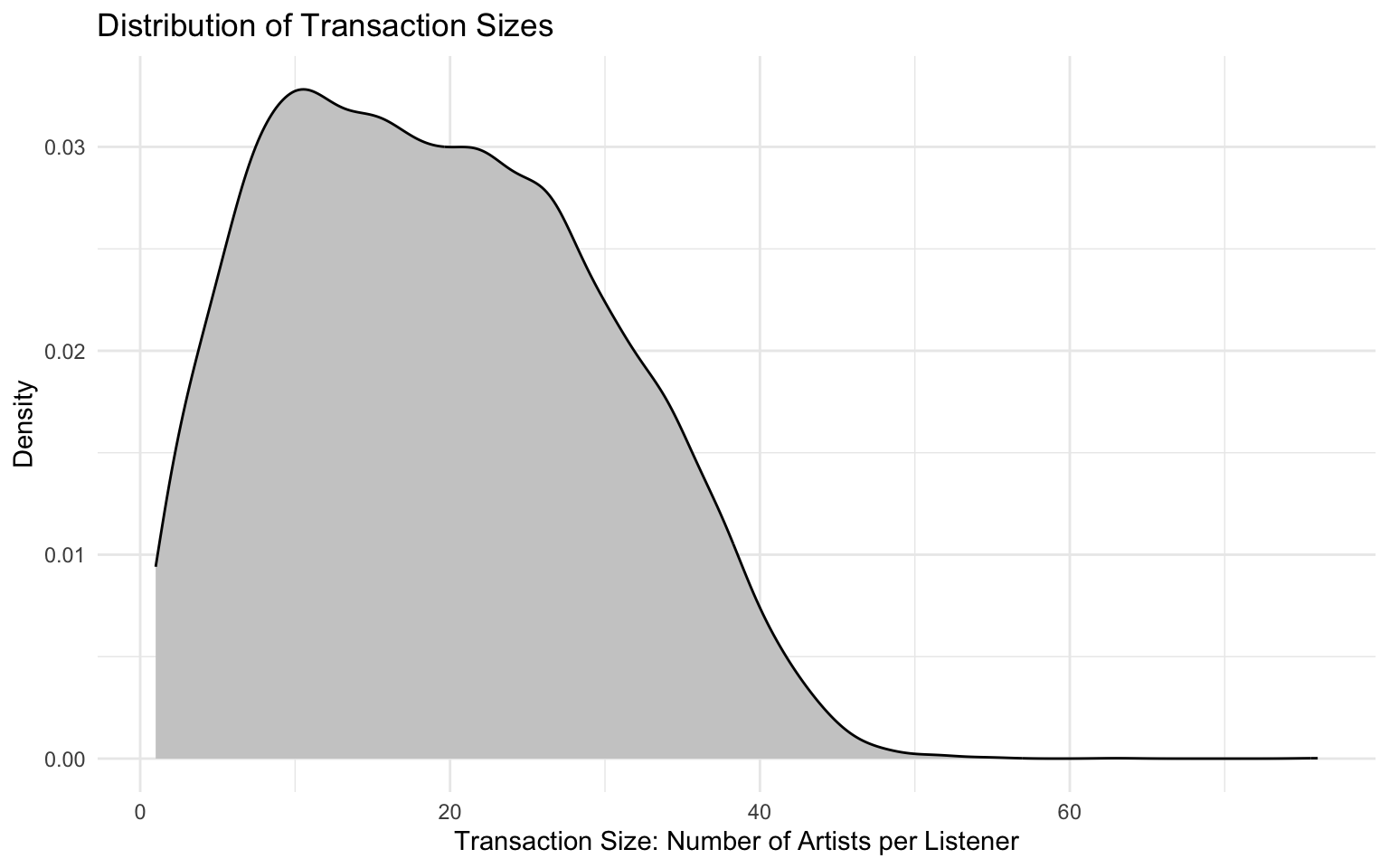
We can also use a histogram, which is often easier to interpret for count data.
tibble(transaction_size = basket_sizes) |>
  ggplot(aes(x = transaction_size)) +
  geom_histogram(binwidth = 5, fill = "grey80", color = "black") +
  labs(
    title = "Histogram of Transaction Sizes",
    x = "Transaction Size: Number of Artists per Listener",
    y = "Number of Listeners"
  ) +
  theme_minimal()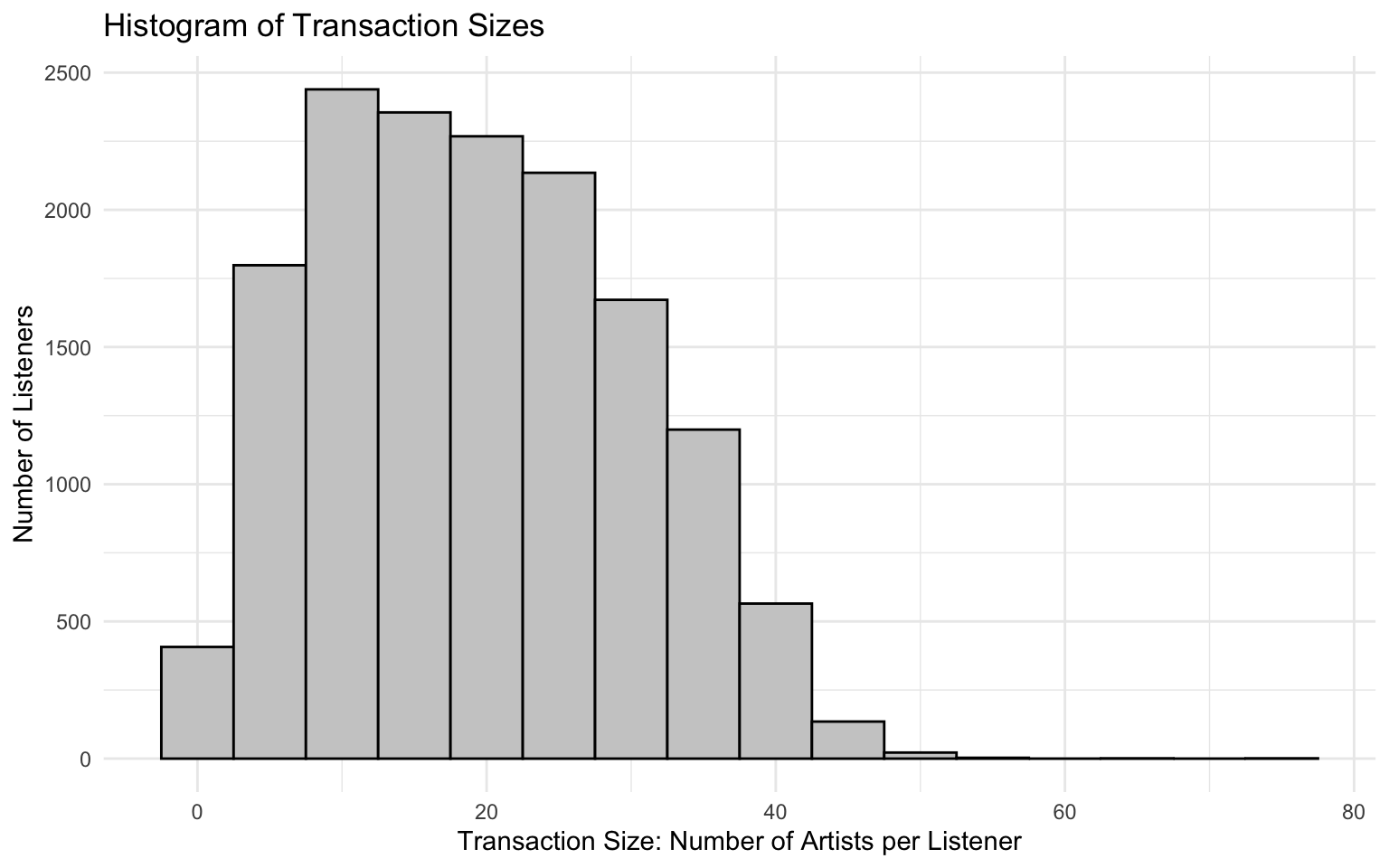
3️⃣ Item Frequencies
Question 3a
Find the top 50 most frequently occurring items in music_eg.
Also find the top 50 least frequently occurring items in music_eg.
Answer
First, we calculate the absolute frequency of each artist.
musicCount    <- itemFrequency(music_eg, "absolute")

musicCount_df <- data.frame(
  artist = names(musicCount),
  count = musicCount,
  row.names = NULL
)

musicCount_df |>
  paged_table()
Top 50 Most Frequent Artists
top_50_artists <- musicCount_df |>
  slice_max(count, n = 50, with_ties = T)

top_50_artists |>
  paged_table()
Top 50 Least Frequent Artists
bottom_50_artists <- musicCount_df |>
  slice_min(count, n = 50, with_ties = T)

bottom_50_artists |>
  paged_table()
Total Number of Artist Occurrences
musicCount_df |>
  summarize(total_artist_occurrences = sum(count))
total_artist_occurrences
1 289952Visualization: Top 50 Most Frequent Artists
top_50_artists |>
  mutate(artist = fct_reorder(artist, count)) |>
  ggplot(aes(x = count, y = artist)) +
  geom_col(fill = "grey70", color = "black") +
  labs(
    title = "Top 50 Most Frequently Occurring Artists",
    x = "Number of Listeners",
    y = "Artist"
  ) +
  theme_minimal()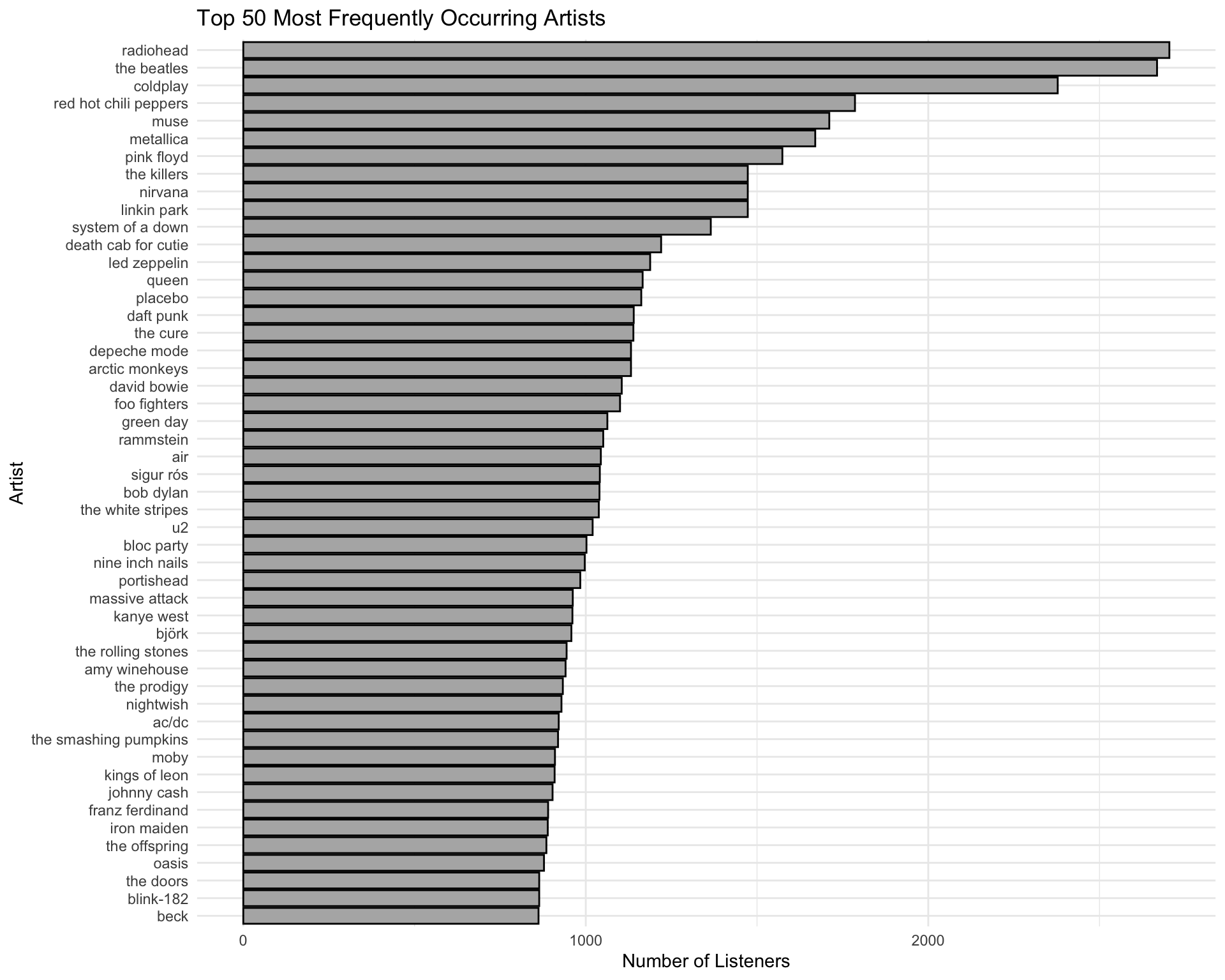
Visualization: Top 50 Least Frequent Artists
bottom_50_artists |>
  mutate(artist = fct_reorder(artist, -count)) |>
  ggplot(aes(x = count, y = artist)) +
  geom_col(fill = "grey70", color = "black") +
  labs(
    title = "Top 50 Least Frequently Occurring Artists",
    x = "Number of Listeners",
    y = "Artist"
  ) +
  theme_minimal()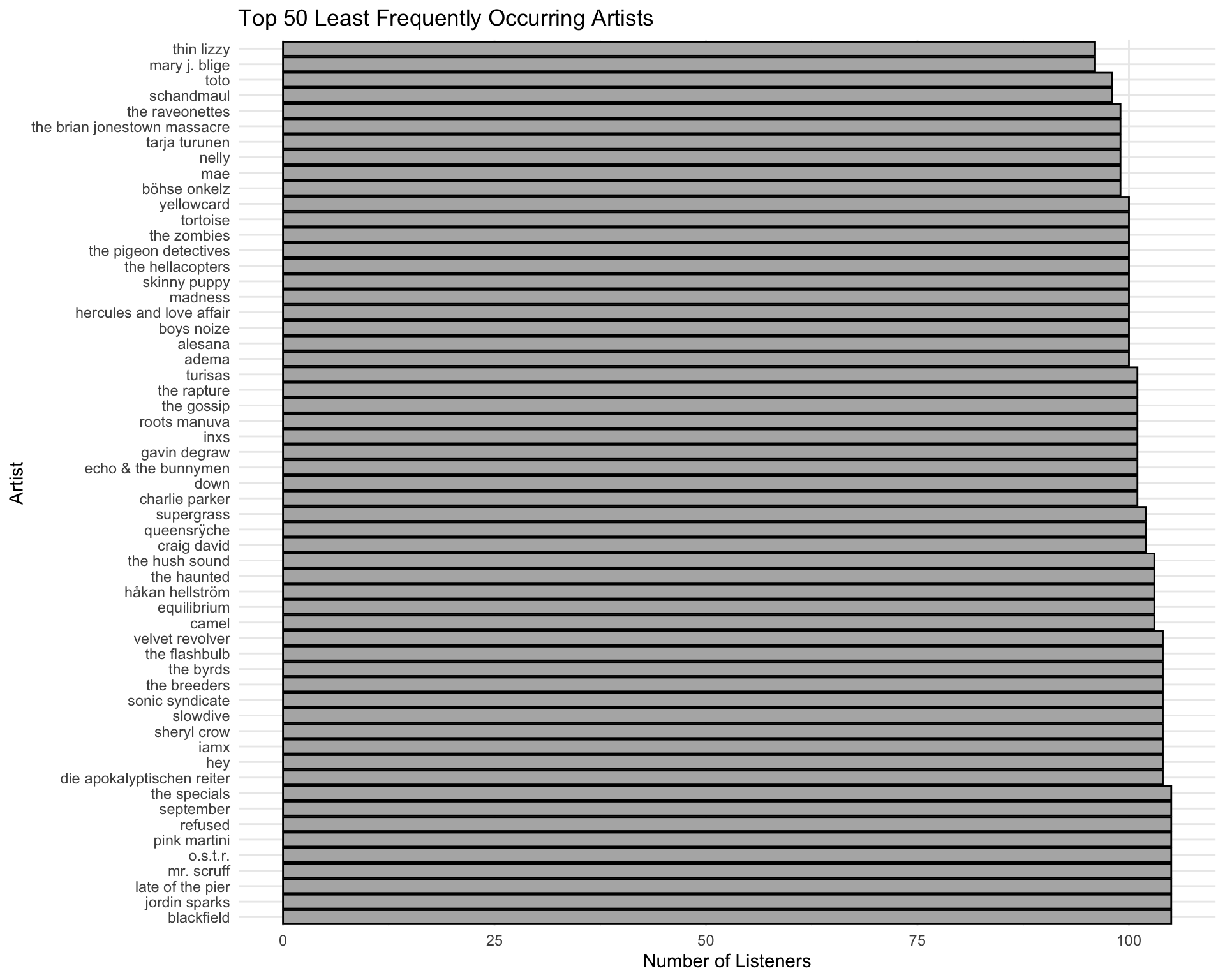
Question 3b [Bonus]
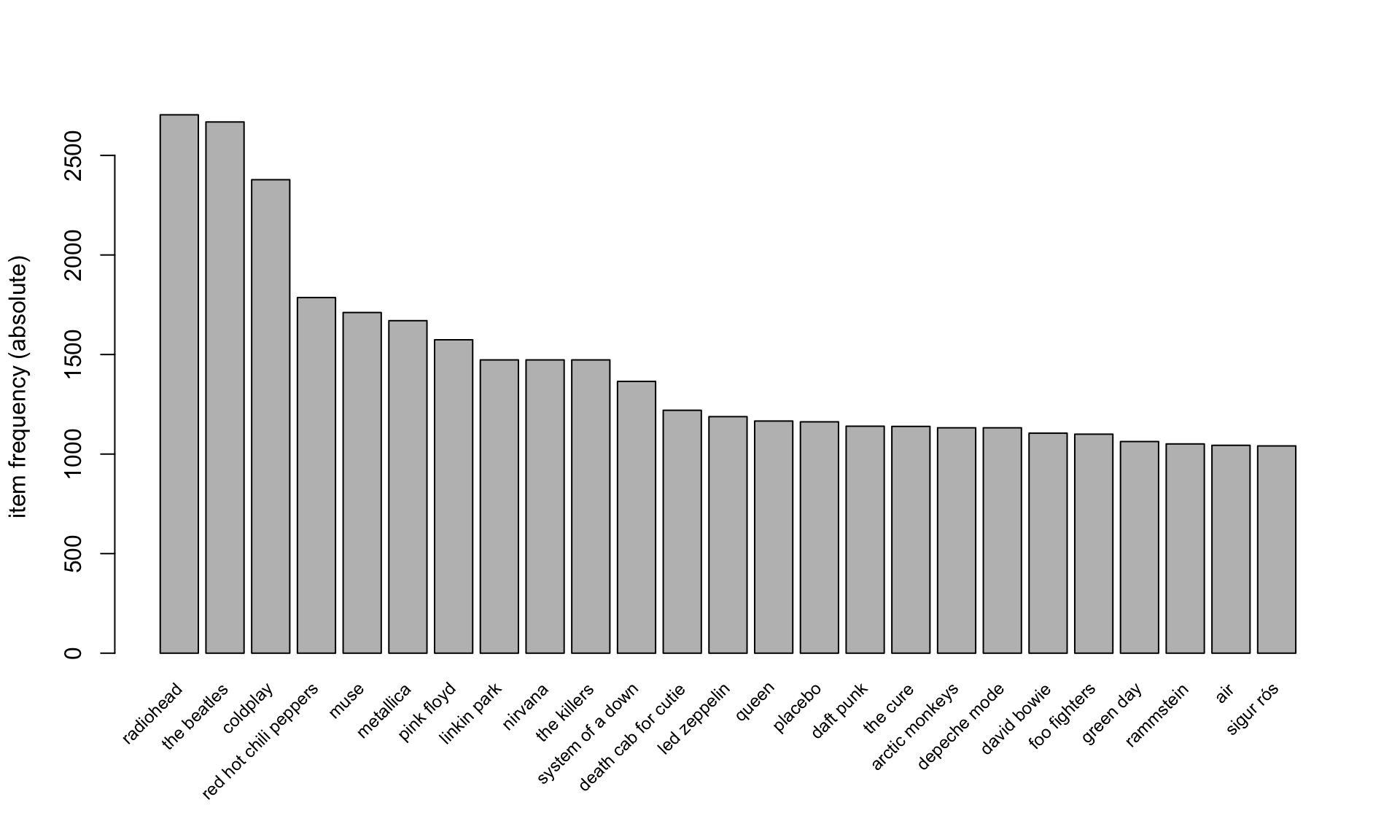
Visualize the distribution of item occurrence using itemFrequencyPlot().
Answer
The function itemFrequencyPlot() is a built-in function from the arules package.
itemFrequencyPlot(
  music_eg,
  type = "absolute",
  topN = 25,
  cex.names = 0.75
)
4️⃣ Association Rules
Before finding association rules, we subset the data to transactions with more than one artist.
musicbaskets_use <- music_eg[basket_sizes > 1]

musicbaskets_use
transactions in sparse format with
14815 transactions (rows) and
1004 items (columns)Question 4a
From the subset of music_eg whose transaction size is greater than 1, find association rules with minimum support 0.01 and minimum confidence 0.5.
Answer
rules <- apriori(
  musicbaskets_use,
  parameter = list(
    support = 0.01,
    confidence = 0.5
  )
)
Apriori
Parameter specification:
confidence minval smax arem aval originalSupport maxtime support minlen
0.5 0.1 1 none FALSE TRUE 5 0.01 1
maxlen target ext
10 rules TRUE
Algorithmic control:
filter tree heap memopt load sort verbose
0.1 TRUE TRUE FALSE TRUE 2 TRUE
Absolute minimum support count: 148
set item appearances ...[0 item(s)] done [0.00s].
set transactions ...[1004 item(s), 14815 transaction(s)] done [0.03s].
sorting and recoding items ... [658 item(s)] done [0.00s].
creating transaction tree ... done [0.00s].
checking subsets of size 1 2 3 4 done [0.01s].
writing ... [55 rule(s)] done [0.00s].
creating S4 object ... done [0.00s].summary(rules)set of 55 rules
rule length distribution (lhs + rhs):sizes
2 3
16 39
Min. 1st Qu. Median Mean 3rd Qu. Max.
2.000 2.000 3.000 2.709 3.000 3.000
summary of quality measures:
support confidence coverage lift
Min. :0.01006 Min. :0.5006 Min. :0.01606 Min. : 2.747
1st Qu.:0.01060 1st Qu.:0.5219 1st Qu.:0.01839 1st Qu.: 3.065
Median :0.01154 Median :0.5498 Median :0.02140 Median : 3.238
Mean :0.01321 Mean :0.5553 Mean :0.02410 Mean : 3.877
3rd Qu.:0.01387 3rd Qu.:0.5839 3rd Qu.:0.02683 3rd Qu.: 3.688
Max. :0.02997 Max. :0.6627 Max. :0.05987 Max. :13.271
count
Min. :149.0
1st Qu.:157.0
Median :171.0
Mean :195.6
3rd Qu.:205.5
Max. :444.0
mining info:
data ntransactions support confidence
musicbaskets_use 14815 0.01 0.5
call
apriori(data = musicbaskets_use, parameter = list(support = 0.01, confidence = 0.5))- Most rules have length 2 or 3:
- 16 rules are simple: {artist A} → {artist B}
- 39 rules are longer: {artist A, artist B} → {artist C}
- Support: 1.01% to 3.00%
- Each rule appears in about 1% to 3% of all music baskets.
- Confidence: 50.1% to 66.3%
- Among listeners with the artist(s) on the left-hand side, about half to two-thirds also have the artist on the right-hand side.
- Lift: 2.75 to 13.27
- These rules show positive associations, meaning the artists appear together more often than expected by chance.
- Count: 149 to 444
- Each rule is based on at least 149 baskets, so the patterns are supported by a meaningful number of observations.
Sort the rules by lift.
rules_lift <- rules |>
  sort(by = "lift", decreasing = TRUE) |>
  head(n = 5)
Instead of relying only on inspect(), we can convert the rules to a tidy table.
rules_tbl <- rules_lift |>
  as("data.frame") |>
  separate(
    col = rules,
    into = c("lhs", "rhs"),
    sep = " => "
  )

rules_tbl |>
  arrange(-lift) |>
  paged_table()
Scatter Plot of Rules
plot(rules_lift)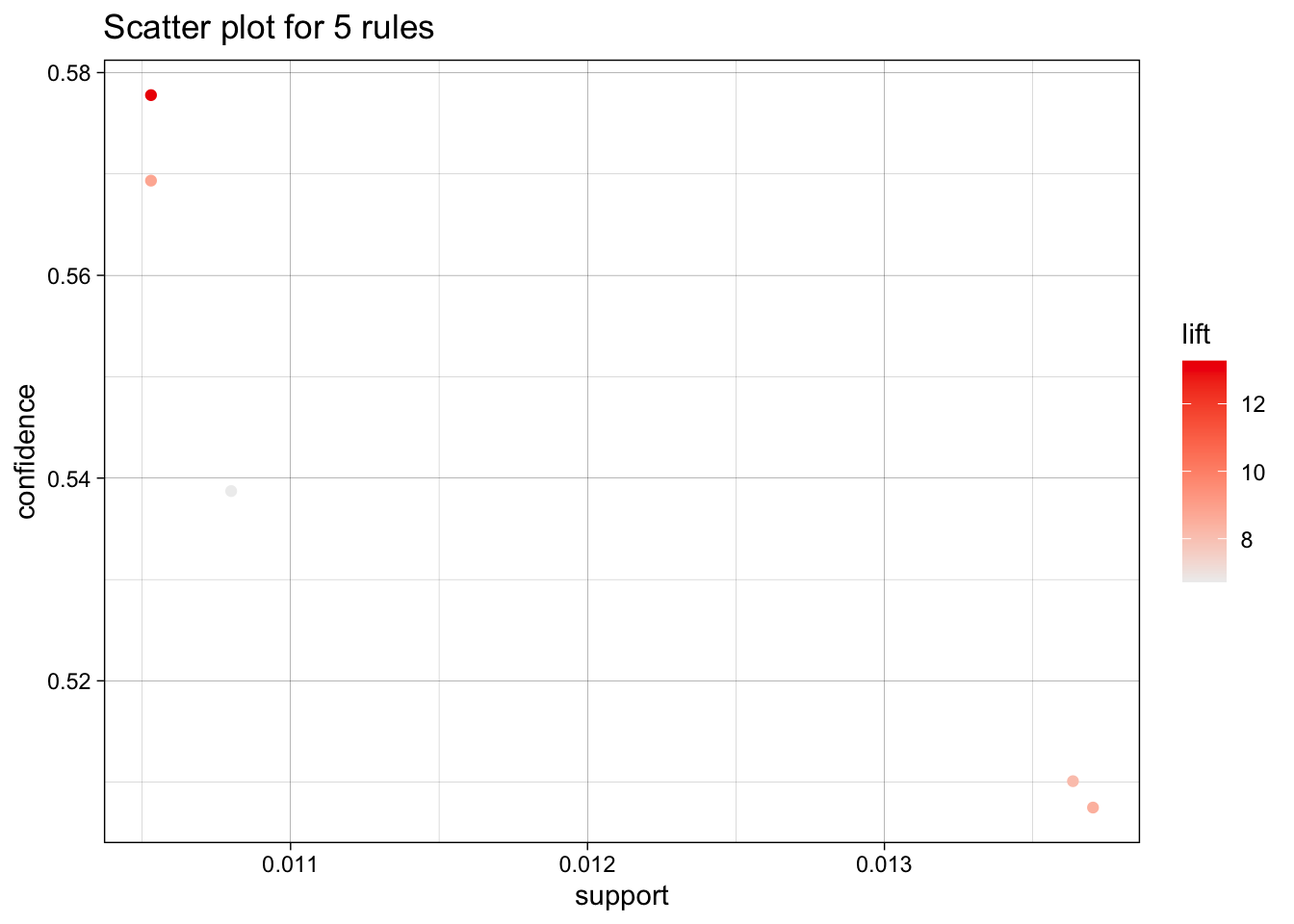
Graph Plot of Rules
plot(rules_lift, method = "graph")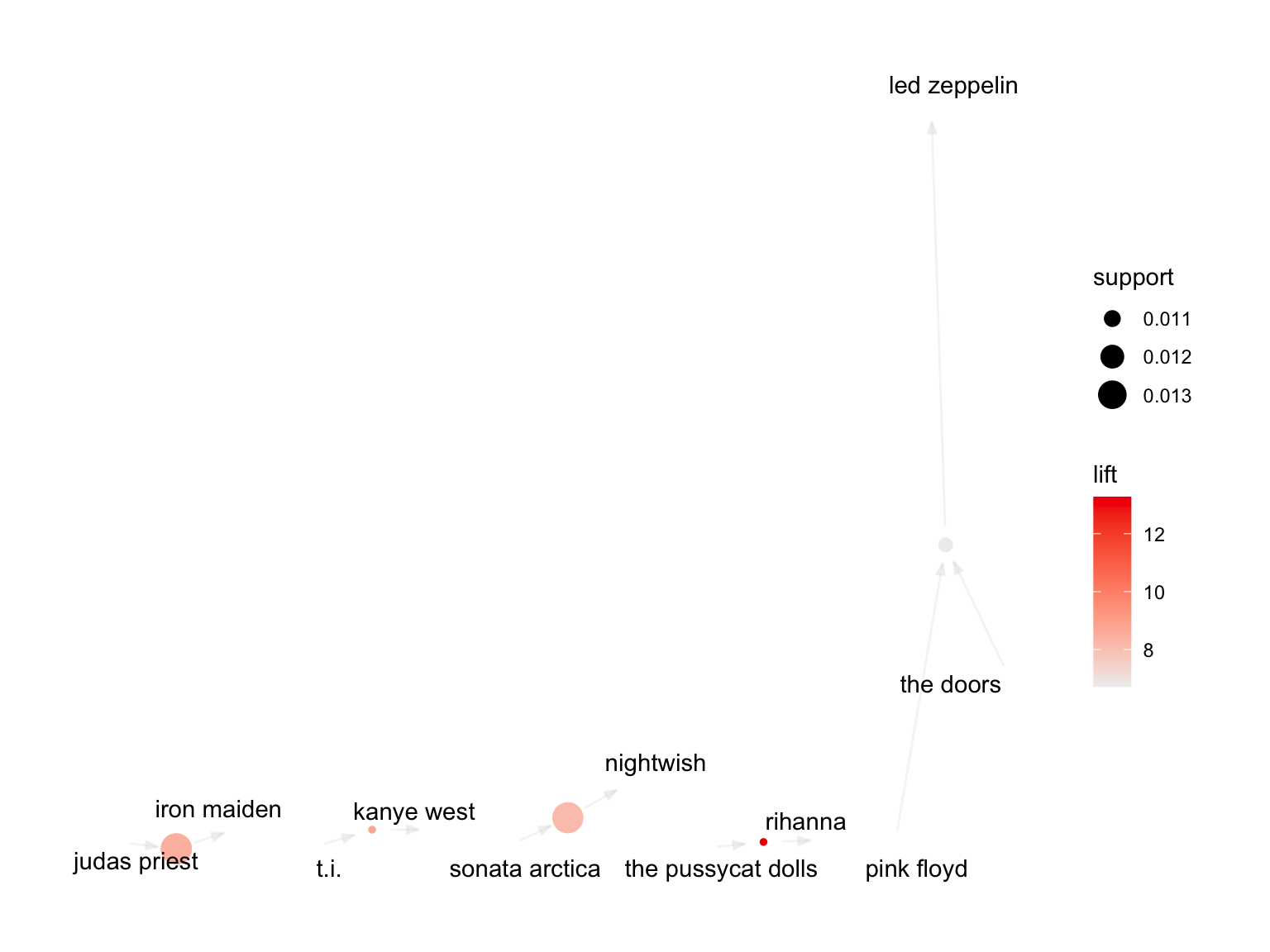
An interactive graph can also be created using the HTML widget engine.
plot(rules_lift, method = "graph", engine = "htmlwidget")Question 4b
Pick one rule from Question 4a. Interpret the following qualities of the rule you pick:
- support
- confidence
- coverage
- lift
- count
Answer
Here, we pick one rule from the rules generated in Question 4a. The following code selects one of the rules with high lift.
picked_rule <- rules_tbl |>
  arrange(desc(lift)) |>
  slice(1)

picked_rule |>
  paged_table()
The selected rule is:
picked_lhs <- picked_rule$lhs
picked_rhs <- picked_rule$rhs
If a listener listened to
{r picked_lhs}, then the listener is also likely to have listened to{r picked_rhs}.
The quality measures for this rule are:
picked_rule |>
  select(lhs, rhs, support, confidence, coverage, lift, count) |>
  paged_table()
Interpretation
Let \(X\) be the item or itemset on the left-hand side, and let \(Y\) be the item on the right-hand side.
Support is the proportion of transactions that contain both \(X\) and \(Y\).
In this rule, support is 0.0105, which means about 1.05% of listeners have both the left-hand-side itemset and the right-hand-side item.Confidence is the conditional probability of \(Y\) given \(X\).
In this rule, confidence is 0.5778, which means that among listeners who listened to{r picked_lhs}, about 57.78% also listened to{r picked_rhs}.Coverage is the proportion of transactions that contain the left-hand-side itemset \(X\).
In this rule, coverage is 0.0182, which means about 1.82% of listeners listened to{r picked_lhs}.Lift compares the observed confidence to the baseline probability of listening to the right-hand-side artist.
In this rule, lift is 13.271. Because this value is greater than 1, the left-hand-side itemset and the right-hand-side item occur together more often than expected under independence.Count is the number of transactions that contain both \(X\) and \(Y\).
In this rule, count is 156, meaning that 156 listeners have both the left-hand-side itemset and the right-hand-side item.
Formula Summary
For a rule \(X \Rightarrow Y\):
\[ \text{support}(X \Rightarrow Y) = P(X \cap Y) \]
\[ \text{confidence}(X \Rightarrow Y) = P(Y \mid X) = \frac{P(X \cap Y)}{P(X)} \]
\[ \text{coverage}(X \Rightarrow Y) = P(X) \]
\[ \text{lift}(X \Rightarrow Y) = \frac{P(Y \mid X)}{P(Y)} \]
Lift can be interpreted as follows:
- If lift is greater than 1, then \(X\) and \(Y\) appear together more often than expected.
- If lift is close to 1, then \(X\) and \(Y\) appear together about as often as expected under independence.
- If lift is less than 1, then \(X\) and \(Y\) appear together less often than expected.
Question 4c
Find at least 5 association rules for the item you pick by setting appropriate levels of minimum support and minimum confidence.
For this example, we will use coldplay as the right-hand-side item.
Answer
First, check whether coldplay is included in the transaction data.
any(itemLabels(music_eg) == "coldplay")[1] TRUENow find association rules where the right-hand-side item is coldplay.
coldplay_rules <- apriori(
  musicbaskets_use,
  parameter = list(
    support = 0.005,
    confidence = 0.6
  ),
  appearance = list(
    rhs = "coldplay",
    default = "lhs"
  )
)
Apriori
Parameter specification:
confidence minval smax arem aval originalSupport maxtime support minlen
0.6 0.1 1 none FALSE TRUE 5 0.005 1
maxlen target ext
10 rules TRUE
Algorithmic control:
filter tree heap memopt load sort verbose
0.1 TRUE TRUE FALSE TRUE 2 TRUE
Absolute minimum support count: 74
set item appearances ...[1 item(s)] done [0.00s].
set transactions ...[1004 item(s), 14815 transaction(s)] done [0.03s].
sorting and recoding items ... [1004 item(s)] done [0.00s].
creating transaction tree ... done [0.00s].
checking subsets of size 1 2 3 4 5 done [0.03s].
writing ... [41 rule(s)] done [0.00s].
creating S4 object ... done [0.00s].summary(coldplay_rules)set of 41 rules
rule length distribution (lhs + rhs):sizes
2 3 4
1 32 8
Min. 1st Qu. Median Mean 3rd Qu. Max.
2.000 3.000 3.000 3.171 3.000 4.000
summary of quality measures:
support confidence coverage lift
Min. :0.005130 Min. :0.6057 Min. :0.006480 Min. :3.773
1st Qu.:0.005400 1st Qu.:0.6270 1st Qu.:0.008100 1st Qu.:3.906
Median :0.005872 Median :0.6556 Median :0.009112 Median :4.085
Mean :0.006982 Mean :0.6665 Mean :0.010587 Mean :4.152
3rd Qu.:0.007695 3rd Qu.:0.6957 3rd Qu.:0.011070 3rd Qu.:4.334
Max. :0.022545 Max. :0.7917 Max. :0.035370 Max. :4.932
count
Min. : 76.0
1st Qu.: 80.0
Median : 87.0
Mean :103.4
3rd Qu.:114.0
Max. :334.0
mining info:
data ntransactions support confidence
musicbaskets_use 14815 0.005 0.6
call
apriori(data = musicbaskets_use, parameter = list(support = 0.005, confidence = 0.6), appearance = list(rhs = "coldplay", default = "lhs"))- Confidence: 60.6% to 79.2%
- Among listeners with the LHS artists, about 61% to 79% also include Coldplay.
- Lift: 3.77 to 4.93
- These listeners are roughly 3.8 to 4.9 times more likely to include Coldplay than average.
- Support: 0.51% to 2.25%
- These patterns appear in a small but meaningful share of all transactions.
- Count: 76 to 334
- Each rule is supported by at least 76 transactions, indicating non-trivial sample size.
Sort the rules by lift.
coldplay_rules_lift <- coldplay_rules |>
  sort(by = "lift", decreasing = TRUE)
Convert the results into a tidy table.
coldplay_rules_tbl <- coldplay_rules_lift |>
  as("data.frame") |>
  separate(
    col = rules,
    into = c("lhs", "rhs"),
    sep = " => "
  ) |>
  arrange(-lift)

coldplay_rules_tbl
lhs rhs support
1 {keane,travis} {coldplay} 0.005129936
2 {keane,u2} {coldplay} 0.005872427
3 {keane,snow patrol} {coldplay} 0.007964900
4 {keane,oasis} {coldplay} 0.006884914
5 {oasis,travis} {coldplay} 0.005467432
6 {arctic monkeys,keane} {coldplay} 0.005332433
7 {oasis,radiohead,the killers} {coldplay} 0.005197435
8 {muse,oasis,the killers} {coldplay} 0.005264934
9 {muse,travis} {coldplay} 0.005197435
10 {death cab for cutie,radiohead,the killers} {coldplay} 0.005467432
11 {keane,the beatles} {coldplay} 0.006479919
12 {death cab for cutie,oasis} {coldplay} 0.006007425
13 {oasis,snow patrol} {coldplay} 0.007694904
14 {keane,muse} {coldplay} 0.007762403
15 {keane,the killers} {coldplay} 0.009652379
16 {keane,radiohead} {coldplay} 0.007694904
17 {bloc party,oasis} {coldplay} 0.005534931
18 {muse,the beatles,the killers} {coldplay} 0.005399933
19 {oasis,the killers} {coldplay} 0.011272359
20 {muse,oasis,radiohead} {coldplay} 0.005332433
21 {radiohead,travis} {coldplay} 0.006682416
22 {kaiser chiefs,oasis} {coldplay} 0.005264934
23 {snow patrol,u2} {coldplay} 0.005872427
24 {red hot chili peppers,snow patrol} {coldplay} 0.006884914
25 {keane} {coldplay} 0.022544718
26 {bloc party,muse,the killers} {coldplay} 0.005804927
27 {radiohead,the beatles,the killers} {coldplay} 0.005872427
28 {radiohead,snow patrol} {coldplay} 0.010192373
29 {franz ferdinand,oasis} {coldplay} 0.006749916
30 {blur,oasis} {coldplay} 0.005467432
31 {the killers,travis} {coldplay} 0.005332433
32 {oasis,the strokes} {coldplay} 0.006074924
33 {the killers,the postal service} {coldplay} 0.005467432
34 {oasis,radiohead,the beatles} {coldplay} 0.005399933
35 {arctic monkeys,snow patrol} {coldplay} 0.005804927
36 {snow patrol,the kooks} {coldplay} 0.005669929
37 {the killers,u2} {coldplay} 0.009179885
38 {death cab for cutie,snow patrol} {coldplay} 0.007694904
39 {arctic monkeys,oasis} {coldplay} 0.008437395
40 {placebo,u2} {coldplay} 0.005197435
41 {muse,oasis} {coldplay} 0.010057374
confidence coverage lift count
1 0.7916667 0.006479919 4.932103 76
2 0.7767857 0.007559906 4.839395 87
3 0.7564103 0.010529868 4.712455 118
4 0.7555556 0.009112386 4.707130 102
5 0.7431193 0.007357408 4.629652 81
6 0.7247706 0.007357408 4.515339 79
7 0.7196262 0.007222410 4.483289 77
8 0.7155963 0.007357408 4.458183 78
9 0.7000000 0.007424907 4.361018 77
10 0.6982759 0.007829902 4.350276 81
11 0.6956522 0.009314884 4.333931 96
12 0.6953125 0.008639892 4.331814 89
13 0.6951220 0.011069862 4.330627 114
14 0.6886228 0.011272359 4.290137 115
15 0.6777251 0.014242322 4.222245 143
16 0.6666667 0.011542356 4.153350 114
17 0.6666667 0.008302396 4.153350 82
18 0.6666667 0.008099899 4.153350 80
19 0.6626984 0.017009787 4.128628 167
20 0.6583333 0.008099899 4.101433 79
21 0.6556291 0.010192373 4.084586 99
22 0.6500000 0.008099899 4.049516 78
23 0.6444444 0.009112386 4.014905 87
24 0.6415094 0.010732366 3.996620 102
25 0.6374046 0.035369558 3.971047 334
26 0.6370370 0.009112386 3.968757 86
27 0.6350365 0.009247384 3.956293 87
28 0.6344538 0.016064799 3.952663 151
29 0.6329114 0.010664867 3.943054 100
30 0.6328125 0.008639892 3.942438 81
31 0.6269841 0.008504894 3.906127 79
32 0.6250000 0.009719879 3.893766 90
33 0.6230769 0.008774890 3.881785 81
34 0.6201550 0.008707391 3.863582 80
35 0.6187050 0.009382383 3.854548 86
36 0.6131387 0.009247384 3.819869 84
37 0.6126126 0.014984813 3.816592 136
38 0.6096257 0.012622342 3.797983 114
39 0.6067961 0.013904826 3.780355 125
40 0.6062992 0.008572393 3.777259 77
41 0.6056911 0.016604792 3.773471 149The following table shows at least five rules for coldplay.
coldplay_rules_tbl |>
  slice_head(n = 5)
lhs rhs support confidence coverage lift
1 {keane,travis} {coldplay} 0.005129936 0.7916667 0.006479919 4.932103
2 {keane,u2} {coldplay} 0.005872427 0.7767857 0.007559906 4.839395
3 {keane,snow patrol} {coldplay} 0.007964900 0.7564103 0.010529868 4.712455
4 {keane,oasis} {coldplay} 0.006884914 0.7555556 0.009112386 4.707130
5 {oasis,travis} {coldplay} 0.005467432 0.7431193 0.007357408 4.629652
count
1 76
2 87
3 118
4 102
5 81Visualization of coldplay Rules
plot(coldplay_rules_lift)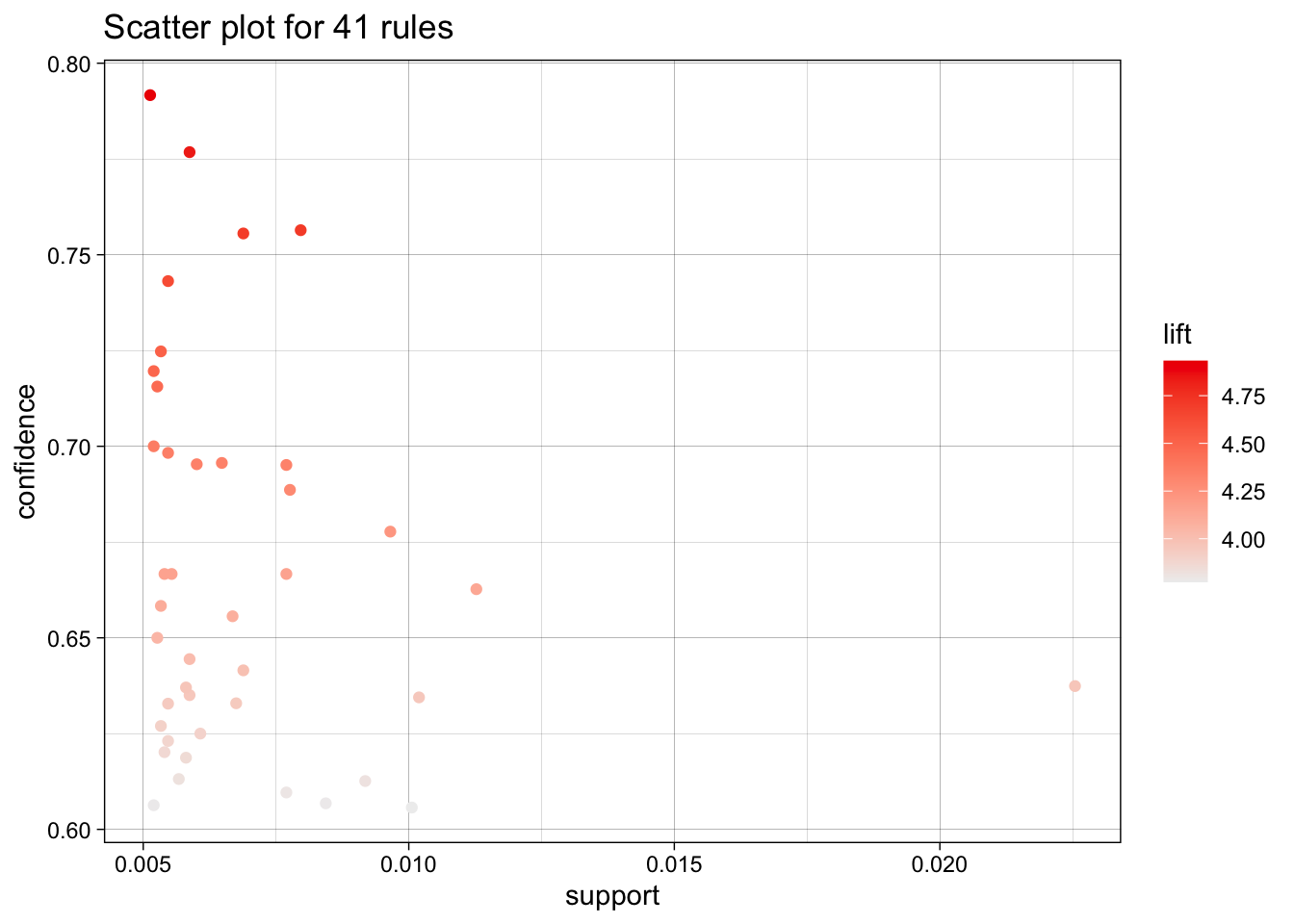
plot(coldplay_rules_lift, method = "graph")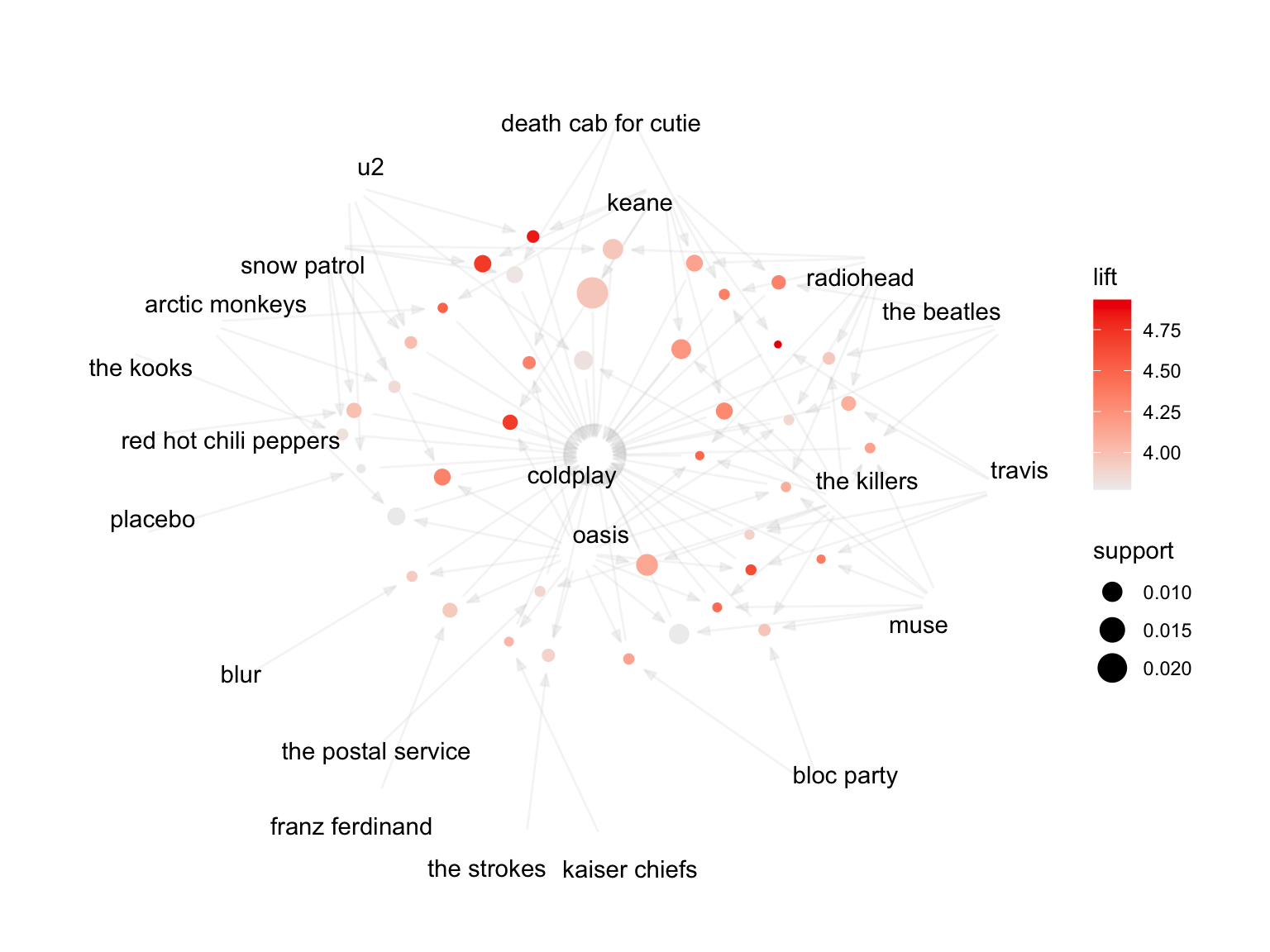
An interactive plot can also be created with plotly.
plot(coldplay_rules_lift, engine = "plotly")✅ Conclusion
This homework used association-rule mining to identify relationships among artists in a music-listening dataset. The key steps were:
- reading music listening data as transaction data;
- summarizing transaction sizes;
- identifying frequent and rare artists;
- mining association rules using
apriori(); - interpreting support, confidence, coverage, lift, and count;
- finding artist-specific rules for
coldplay.