🤖 Lecture 9

Generative AI, Agents, and the Job Market

Byeong-Hak Choe

SUNY Geneseo

November 9, 2026

🧠 From predictive AI to deep learning

📈 What machine learning did well

🏨 Hotels

Forecast demand from weather, events, and rival prices

📦 Amazon

Forecast orders, arrange shelves, run warehouse robots

📺 Your feed

Guess what to show you next

  • Its limit: narrow tasks. It couldn’t handle language well.

🕸️ What is a neural network?

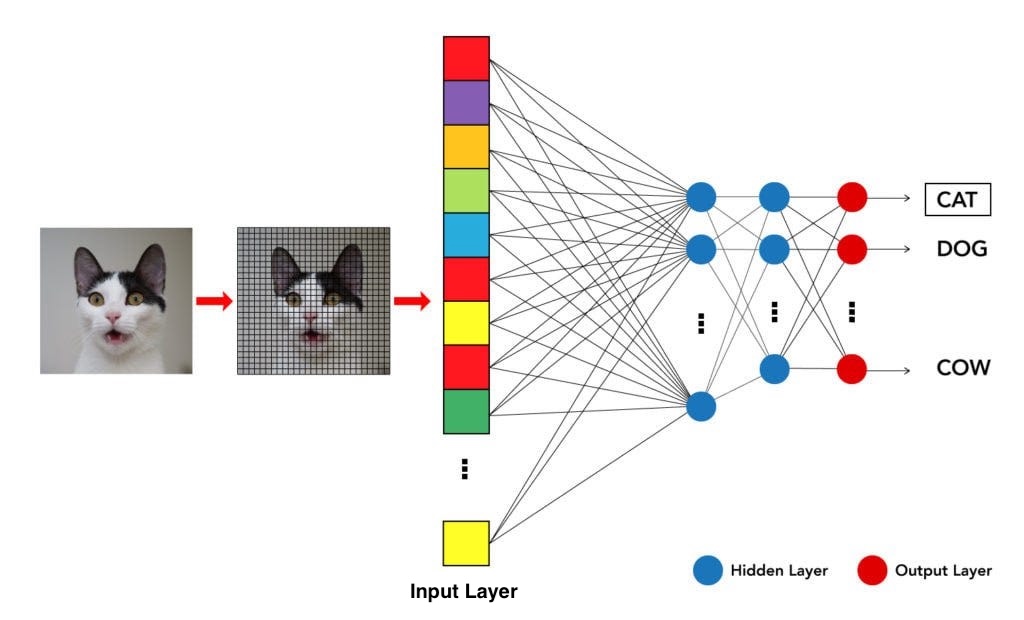
A neural network with input, hidden, and output layers classifying an image as a cat.

  • Input layer takes in the data.
  • Hidden layers transform it.
  • Output layer gives the answer.

✨ Inside Generative AI

🛠️ Generative AI in an analyst’s work

Prepare

Draft a data dictionary. Organize text.

Analyze

Suggest R code. Explain an error.

Communicate

Propose chart titles. Critique a claim.

  • The bottleneck moves from doing to directing and checking.

🔮 How an LLM writes

🧱 What is a token?

cat playing extraordinary !

  • The smallest unit of text an LLM reads and writes.
  • A word, part of a word, or a symbol.
  • Exact splits vary by model.

🔁 From prompt to next token

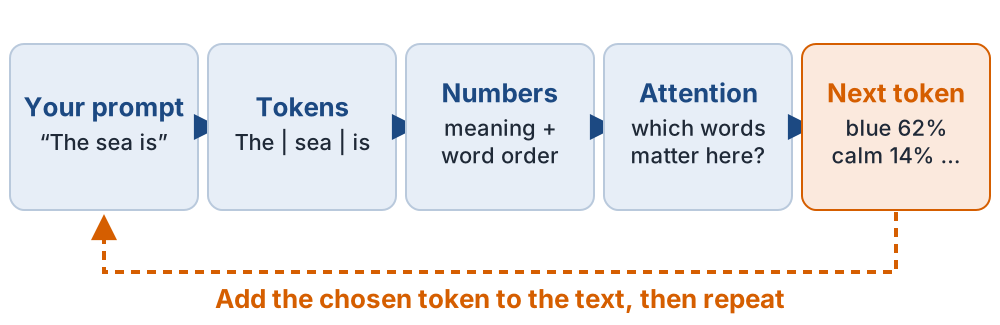
A prompt becomes tokens, then numbers, passes through attention, and yields next-token probabilities; the chosen token is added and the process repeats.

🏋️ Training, context, and tools

🏋️ Two phases of training

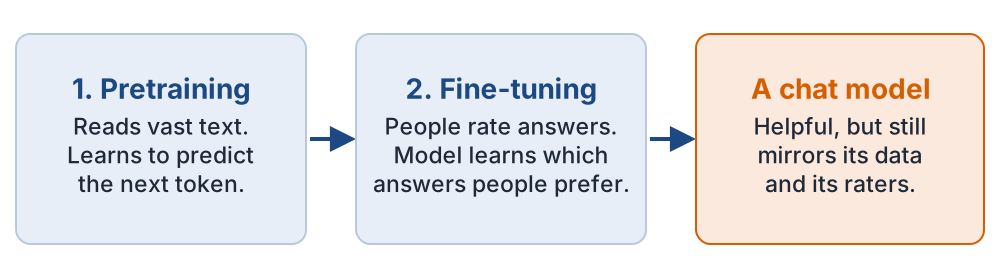
Two training phases: pretraining on vast text, then fine-tuning with human ratings, producing a chat model.

  • Pretraining reads odd things: the web, books, even Enron’s emails.
  • Models learn biases and errors along with facts.

📖 Anthropic’s Project Panama
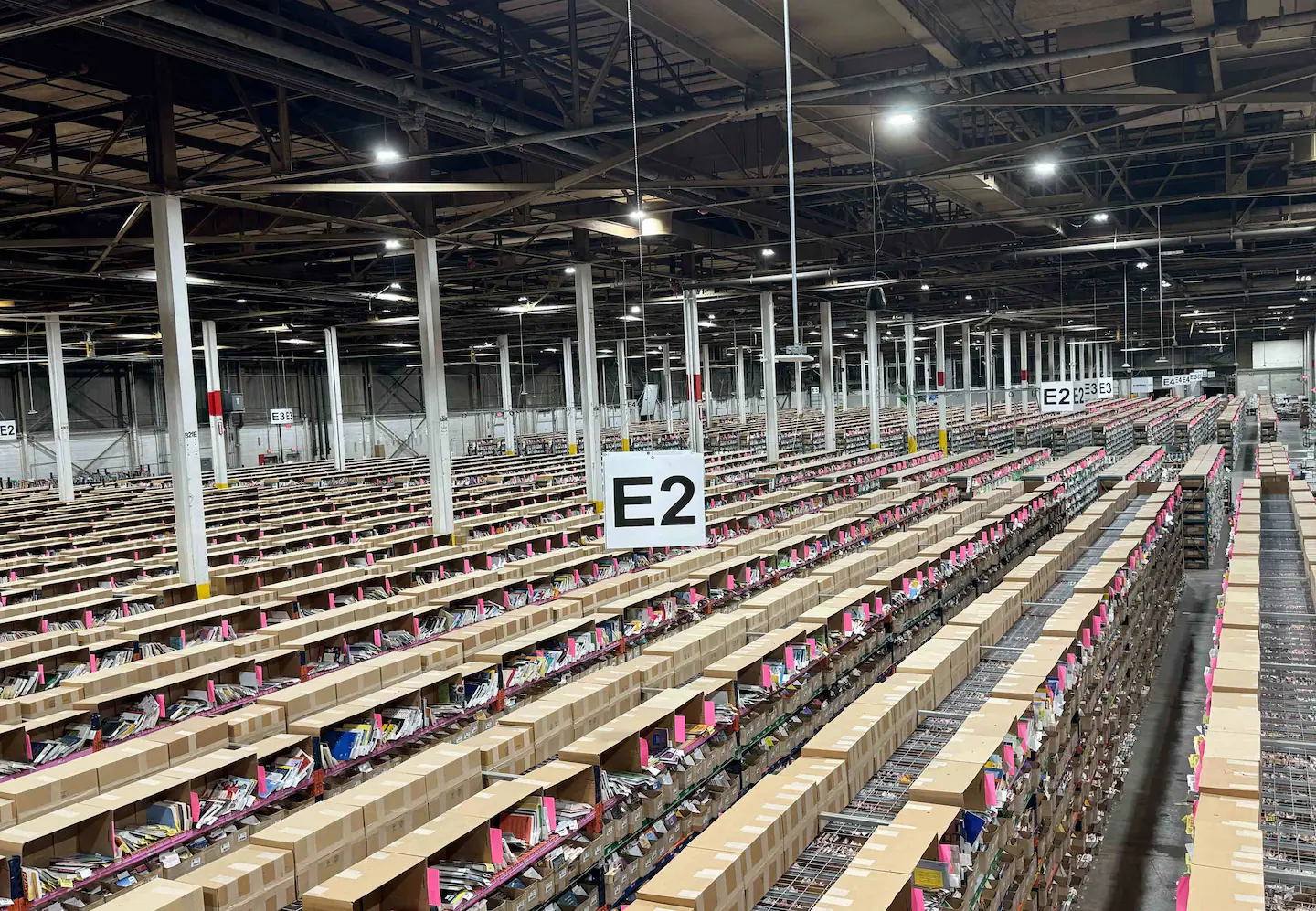
A warehouse with rows of shelves holding print books.

🛡️ Working with AI, Responsibly

🎯 Alignment at a smaller scale

A narrow target

“Make the average recorded wait as low as possible.”

What if difficult orders are turned away?

The real goal

Serve customers well with reasonable waits.

Track service quality, and who is left out.

  • Alignment: directing AI toward human goals and limits.

📜 Working with AI: four rules

📜 Four rules for co-intelligence

1. Always invite AI to the table

2. Be the human in the loop

3. Treat AI like a person (but tell it what kind of person it is)

4. Assume this is the worst AI you will ever use

🧑‍⚖️ Responsible use of AI

🧑‍⚖️ Responsible use: four questions

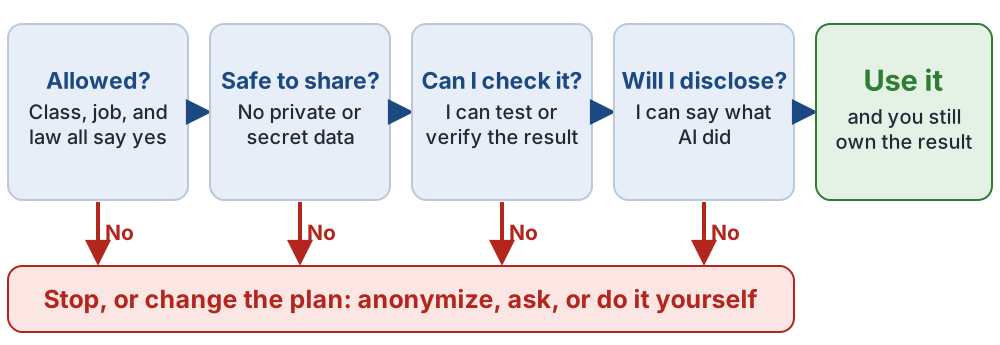
Four checks before using AI: is it allowed, is the data safe to share, can I check the result, and will I disclose it. Any no means stop or change the plan.

🔄 AI agents

🔄 What is an AI agent?

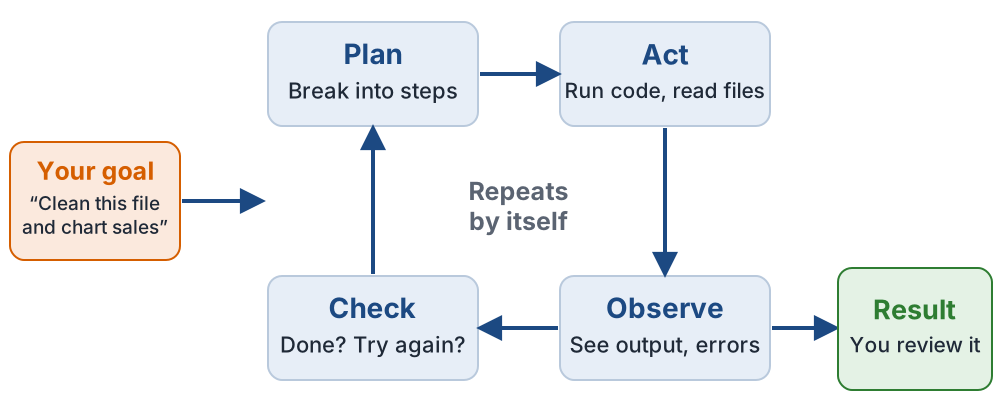
An agent loop: from a goal, the agent plans, acts, observes, and checks repeatedly, then returns a result for a person to review.

🧰 An agent on a data task

The agent… You check…
reads sales.csv Right file? All the rows?
writes and runs dplyr code Does it answer the question?
fixes its own errors What did it drop or change?
makes a chart Are the axes and labels honest?
writes a summary Can you trace every number?

🔍 Andrej Karpathy’s AI gap

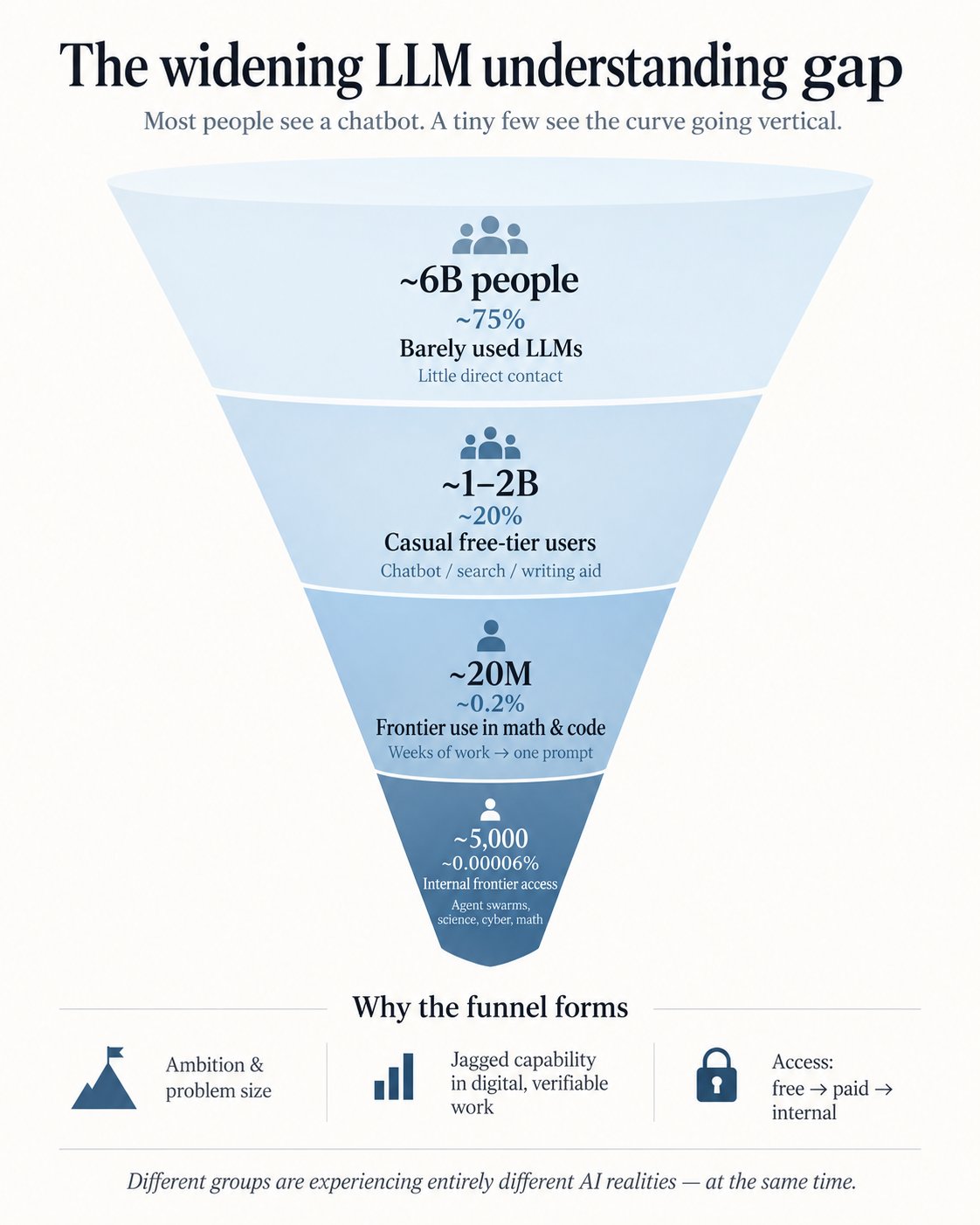
A funnel contrasts people with little exposure to language models, casual chatbot users, advanced users, and people with access to unreleased tools. The population figures are rough estimates.

💼 AI and jobs

📦 A job is a bundle of tasks

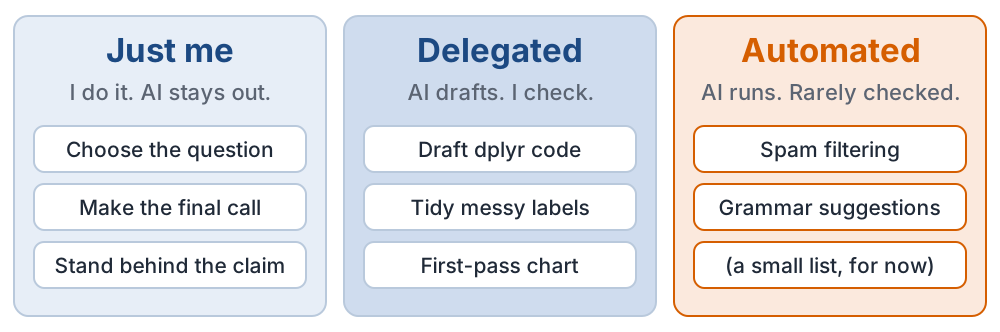
An analyst's tasks sorted into three groups: just me, delegated, and automated.

  • AI takes tasks. Whether it takes the job is a separate question.

📊 What does each study measure?

Measure What the evidence shows
Exposure The ILO estimates that 1 in 4 workers globally are in occupations with some tasks potentially affected by generative AI.
Productivity At one firm, customer-support workers resolved 15% more issues per hour on average after receiving AI assistance.
Employment The Yale Budget Lab’s October 2026 analysis found no clear AI-related shift in the overall U.S. labor market using its measures.

💼 But watch young workers

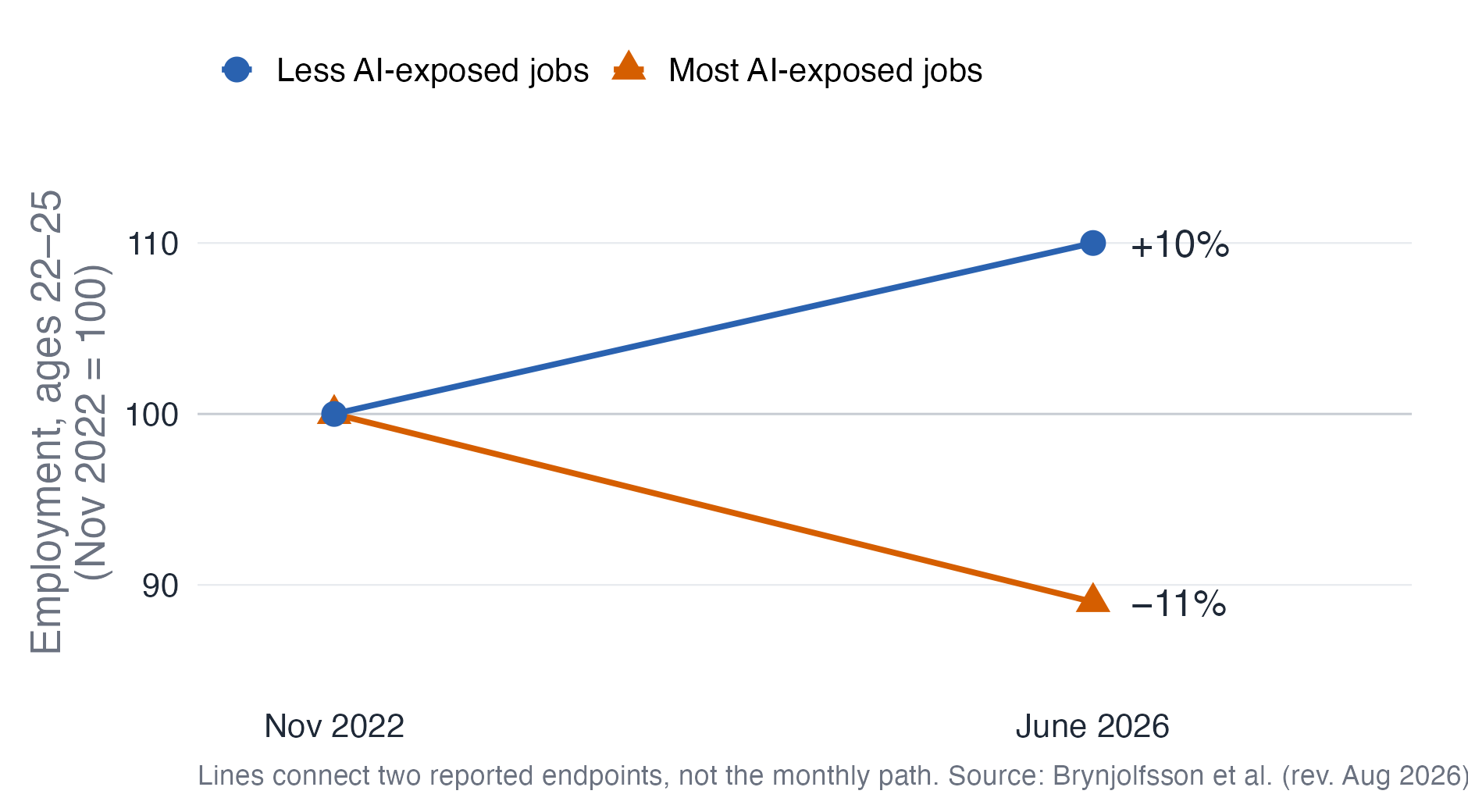
Line chart from November 2022 to June 2026 for workers ages 22 to 25: employment rose 10 percent in less AI-exposed jobs and fell 11 percent in the most AI-exposed jobs.

  • From November 2022 to June 2026, employment among workers ages 22–25 fell 11% in the most AI-exposed occupations and rose 10% in less exposed occupations, a gap of 21 percentage points.